Deploy Front-end
In this step, we will create an S3 bucket with Static website hosting enabled and publicly accessible using AWS SAM.
Edit SAM Template
Open the template.yaml file in the fcaj-book-shop folder that we created in Part 1.
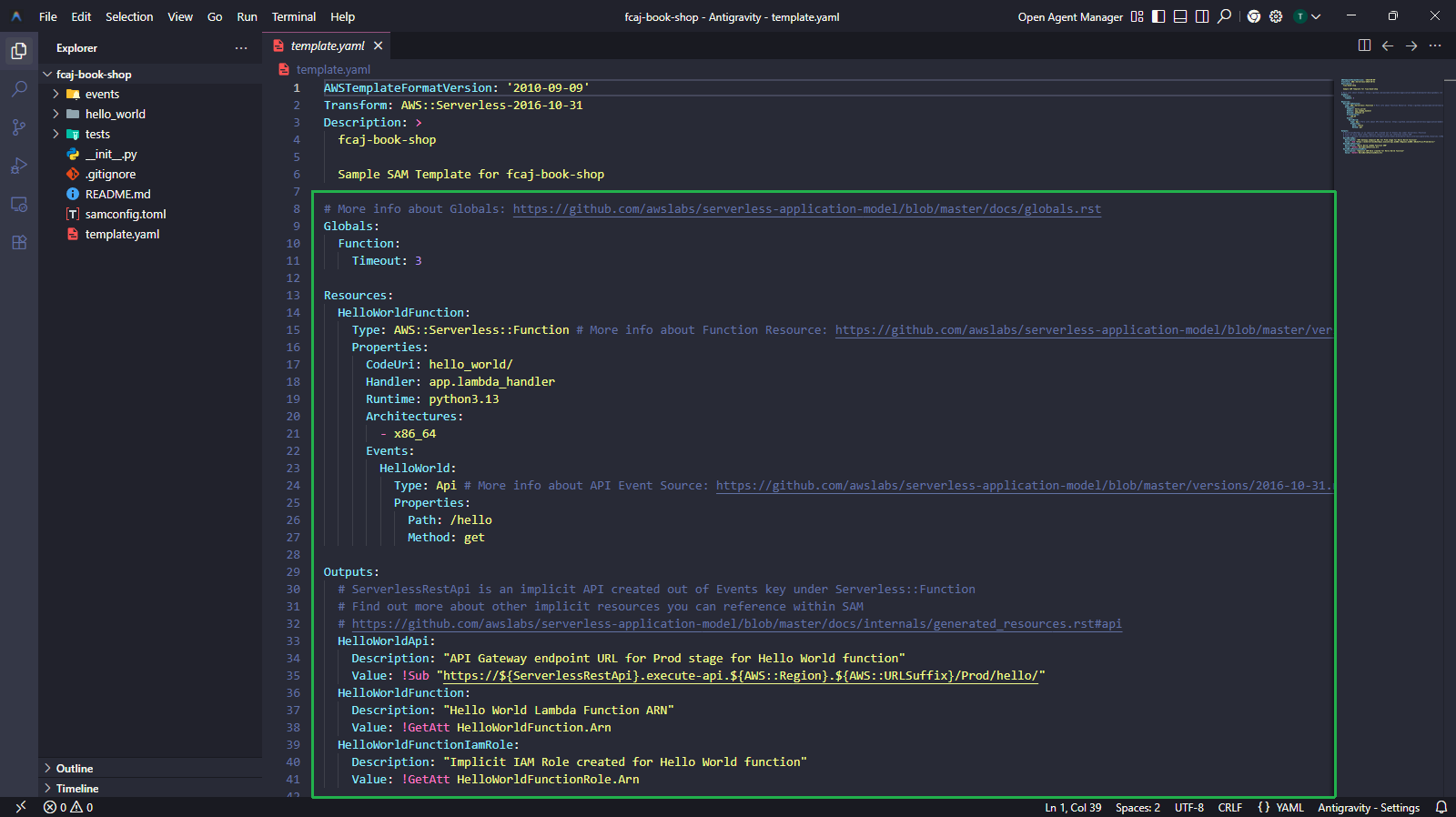
Delete the unnecessary parts (highlighted in the image above), including:
- Resources:
HelloWorldFunctionand its related Events. - Outputs: The entire Outputs section.
- Resources:
Add the Parameters section after
Globalsto define the bucket name:Parameters: FCAJBookShopBucketName: Type: String Default: fcaj-book-shop-by-myself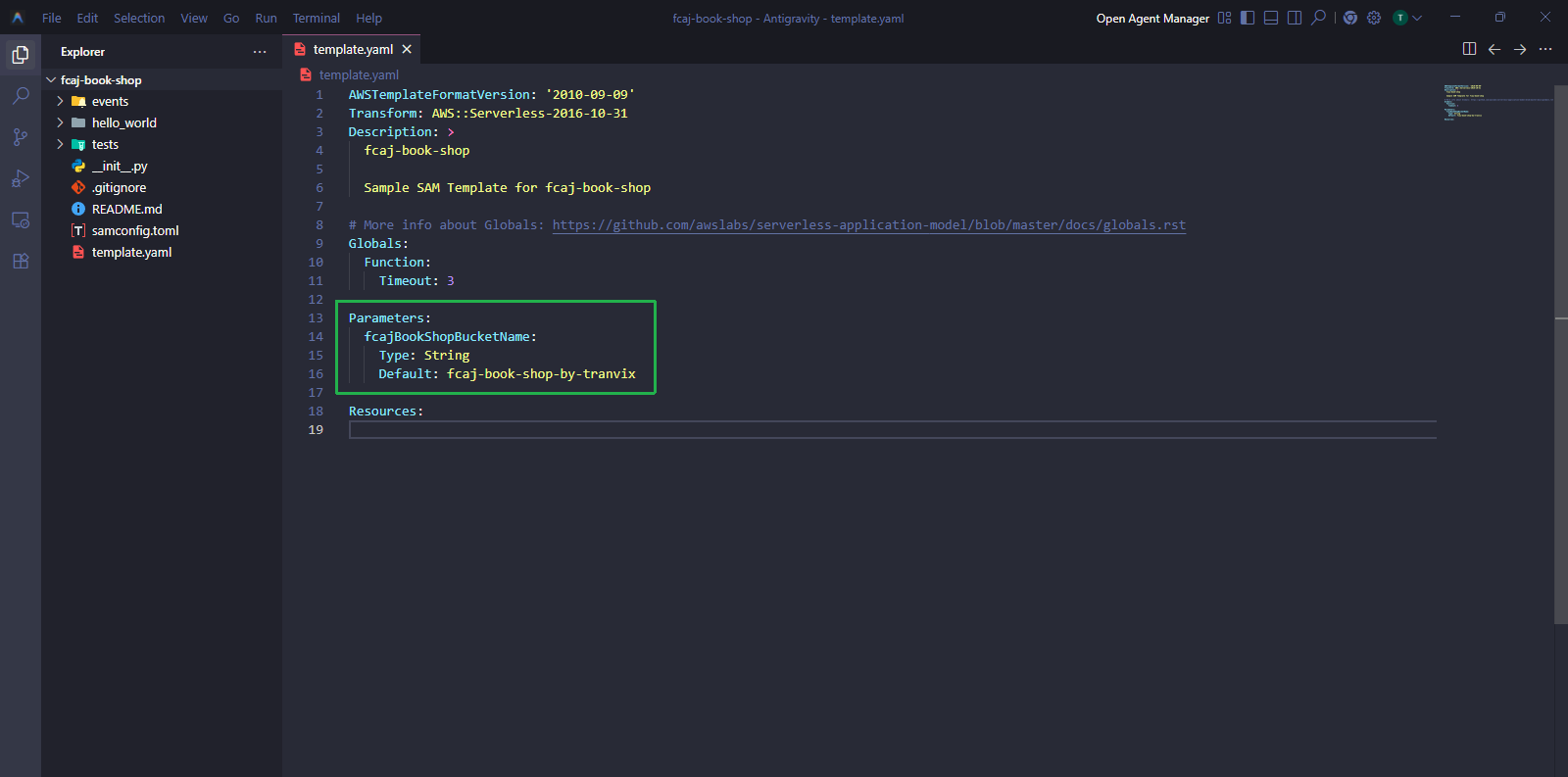
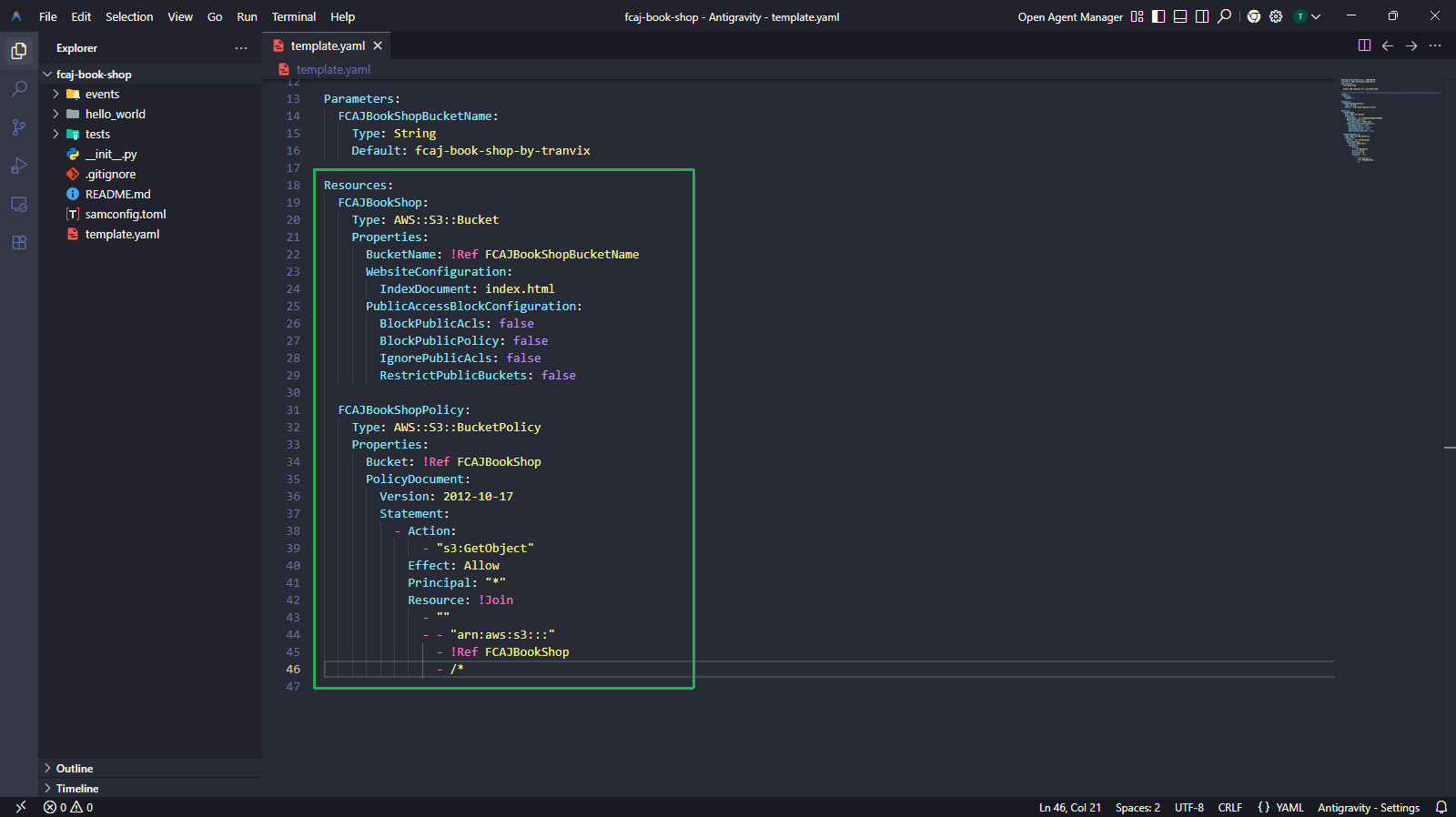
Add the Resources section to create the S3 Bucket and Bucket Policy:
Resources:
  FCAJBookShop:
    Type: AWS::S3::Bucket
    Properties:
      BucketName: !Ref FCAJBookShopBucketName
      WebsiteConfiguration:
        IndexDocument: index.html
      PublicAccessBlockConfiguration:
        BlockPublicAcls: false
        BlockPublicPolicy: false
        IgnorePublicAcls: false
        RestrictPublicBuckets: false

  FCAJBookShopPolicy:
    Type: AWS::S3::BucketPolicy
    Properties:
      Bucket: !Ref FCAJBookShop
      PolicyDocument:
        Version: 2012-10-17
        Statement:
          - Action:
              - "s3:GetObject"
            Effect: Allow
            Principal: "*"
            Resource: !Join
              - ""
              - - "arn:aws:s3:::"
                - !Ref FCAJBookShop
                - /*
The script above defines:
- FCAJBookShop: An S3 bucket with Static Website Hosting enabled and all Public Access Blocks disabled.
- FCAJBookShopPolicy: A Bucket Policy that allows everyone (
Principal: "*") to read (s3:GetObject) all objects in the bucket.
Build and Deploy with SAM
Run the sam build command at the SAM project directory (fcaj-book-shop) to build the application:
sam build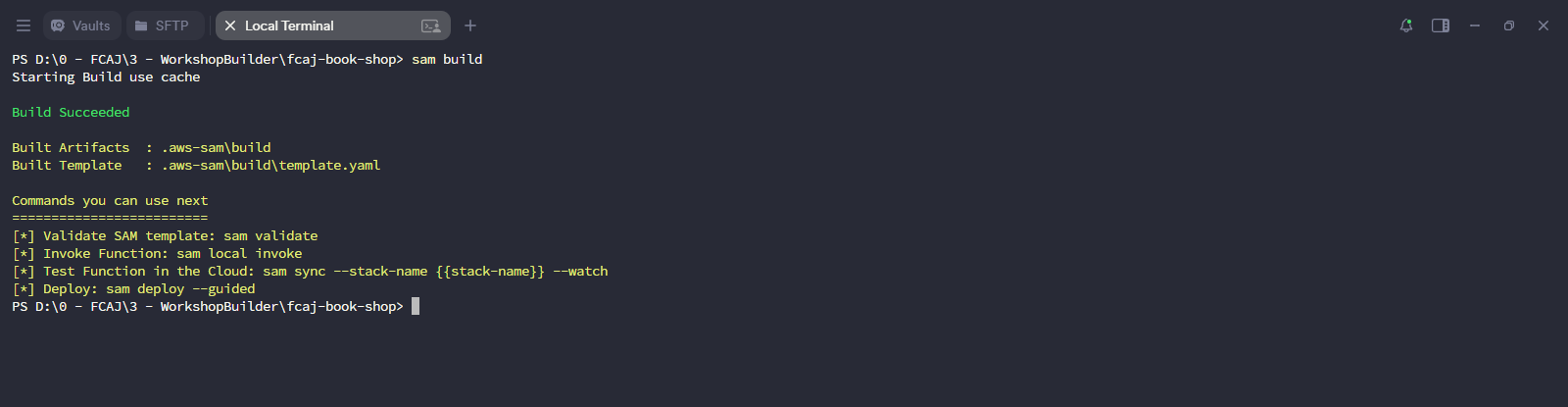
Validate the SAM template:
sam validate
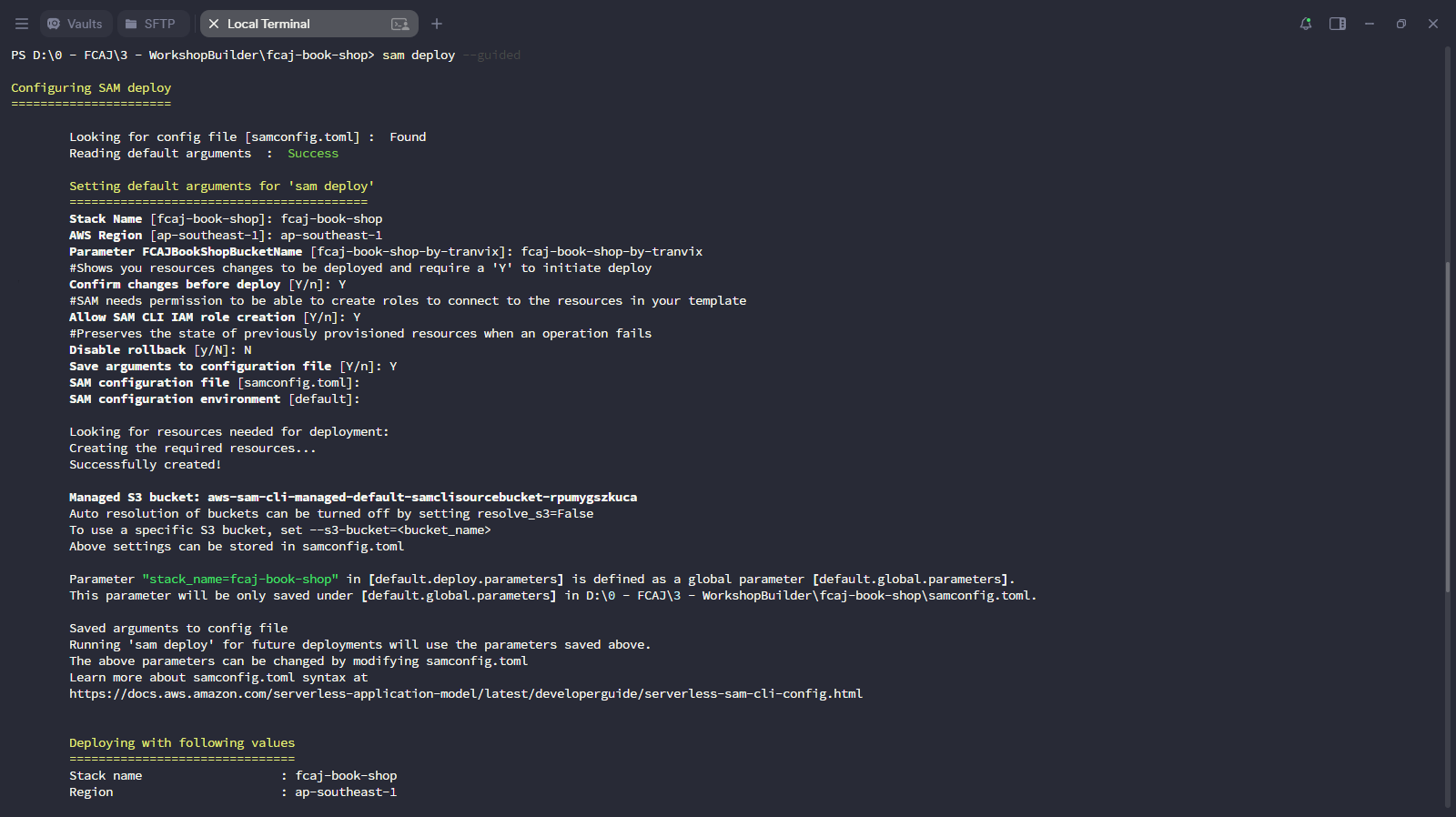
Deploy SAM in guided mode (step-by-step):
sam deploy --guidedEnter the following information when prompted:
- Stack Name:
fcaj-book-shop - AWS Region:
ap-southeast-1(or your preferred deployment region). - Parameter FCAJBookShopBucketName: Keep the default value or enter your desired bucket name.
- Confirm changes before deploy:
Y - Allow SAM CLI IAM role creation:
Y - Disable rollback:
N - Save arguments to configuration file:
Y
- Stack Name:
S3 bucket names must be globally unique. If the name fcaj-book-shop-by-myself is already taken, change it to something unique (e.g., fcaj-book-shop-by-yourname).
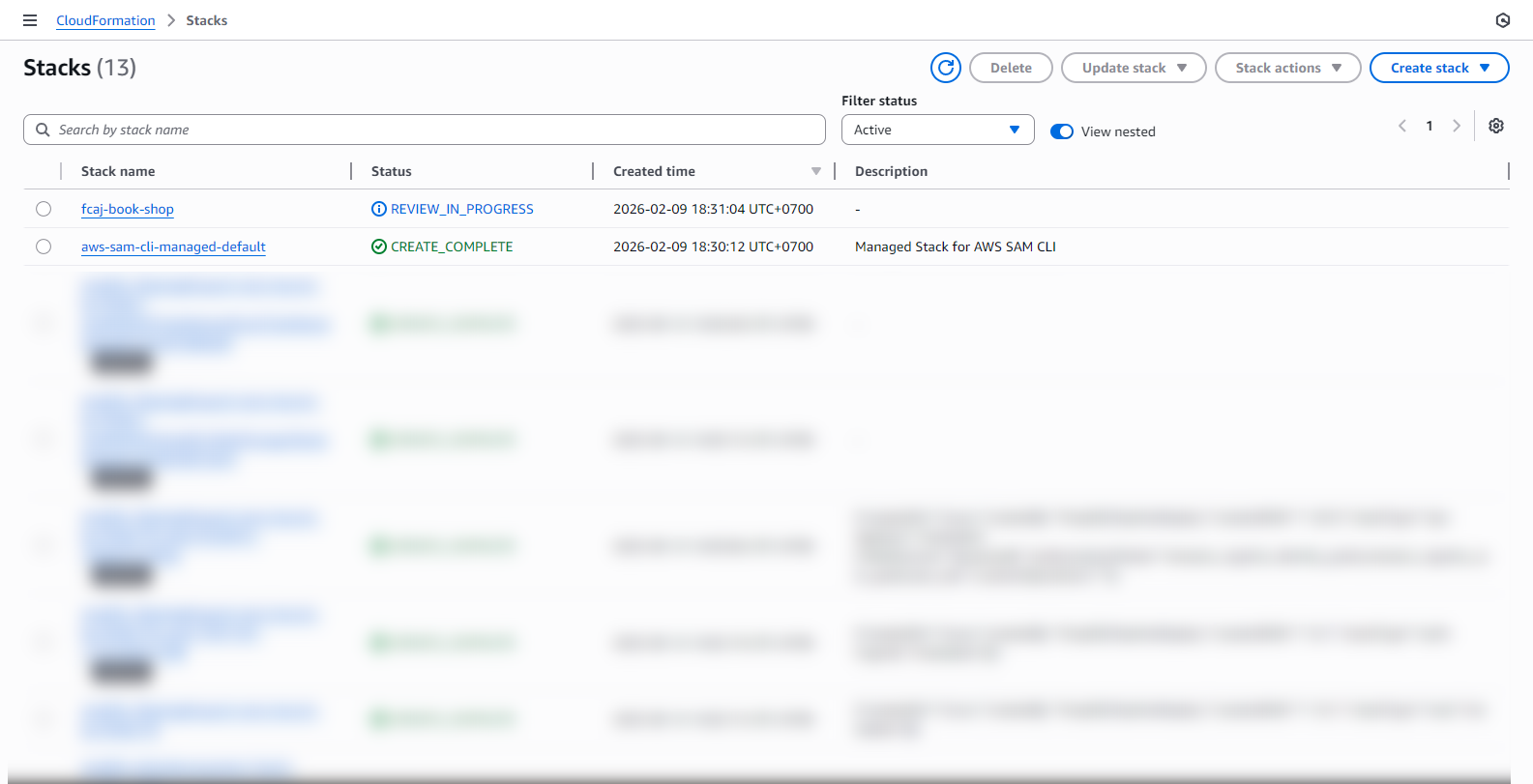
While waiting for the deployment, you can open the CloudFormation console to monitor the stack creation progress.
Wait for the changeset creation to complete. When prompted Deploy this changeset?, enter
yto confirm the deployment.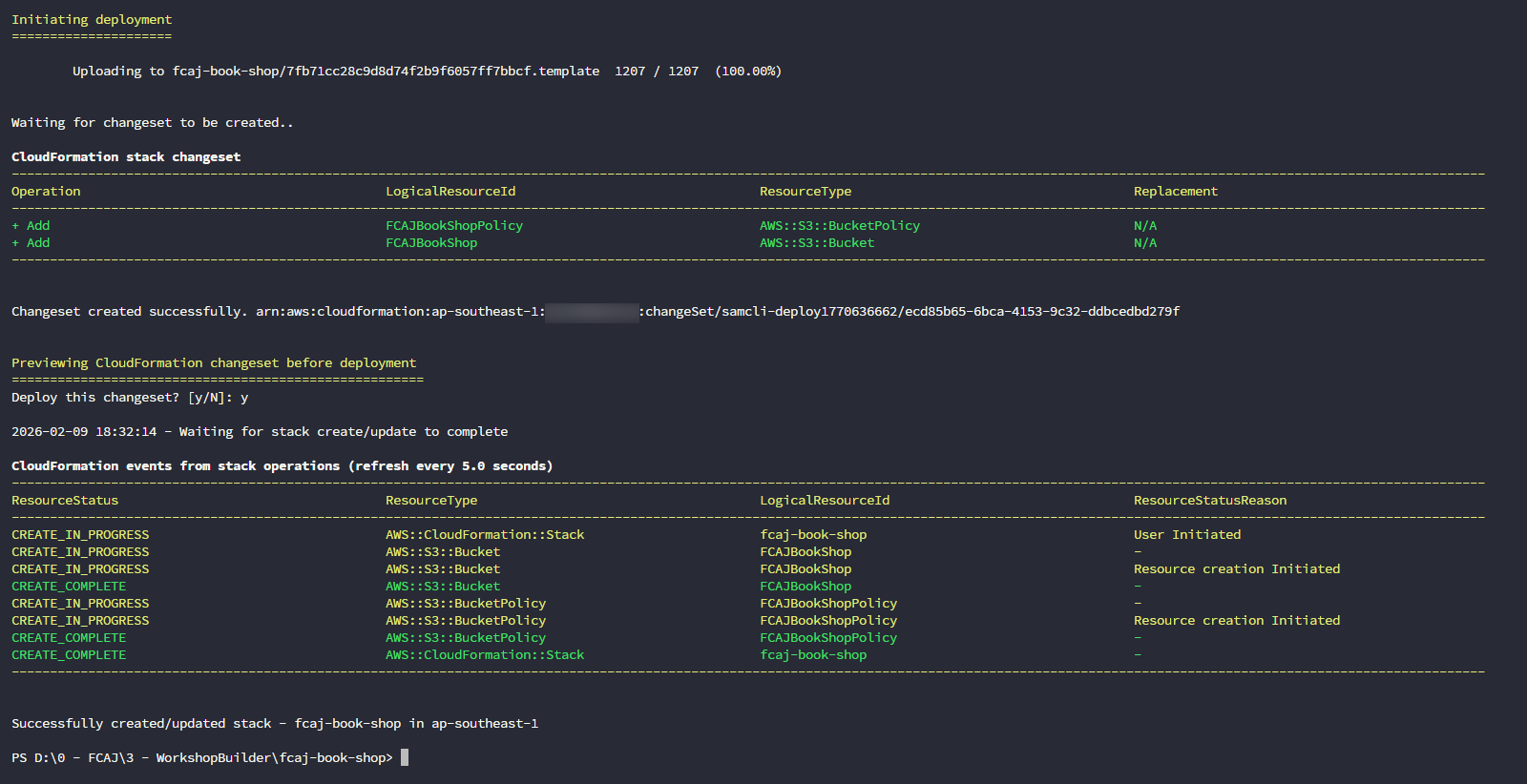
Verify Results on AWS Console
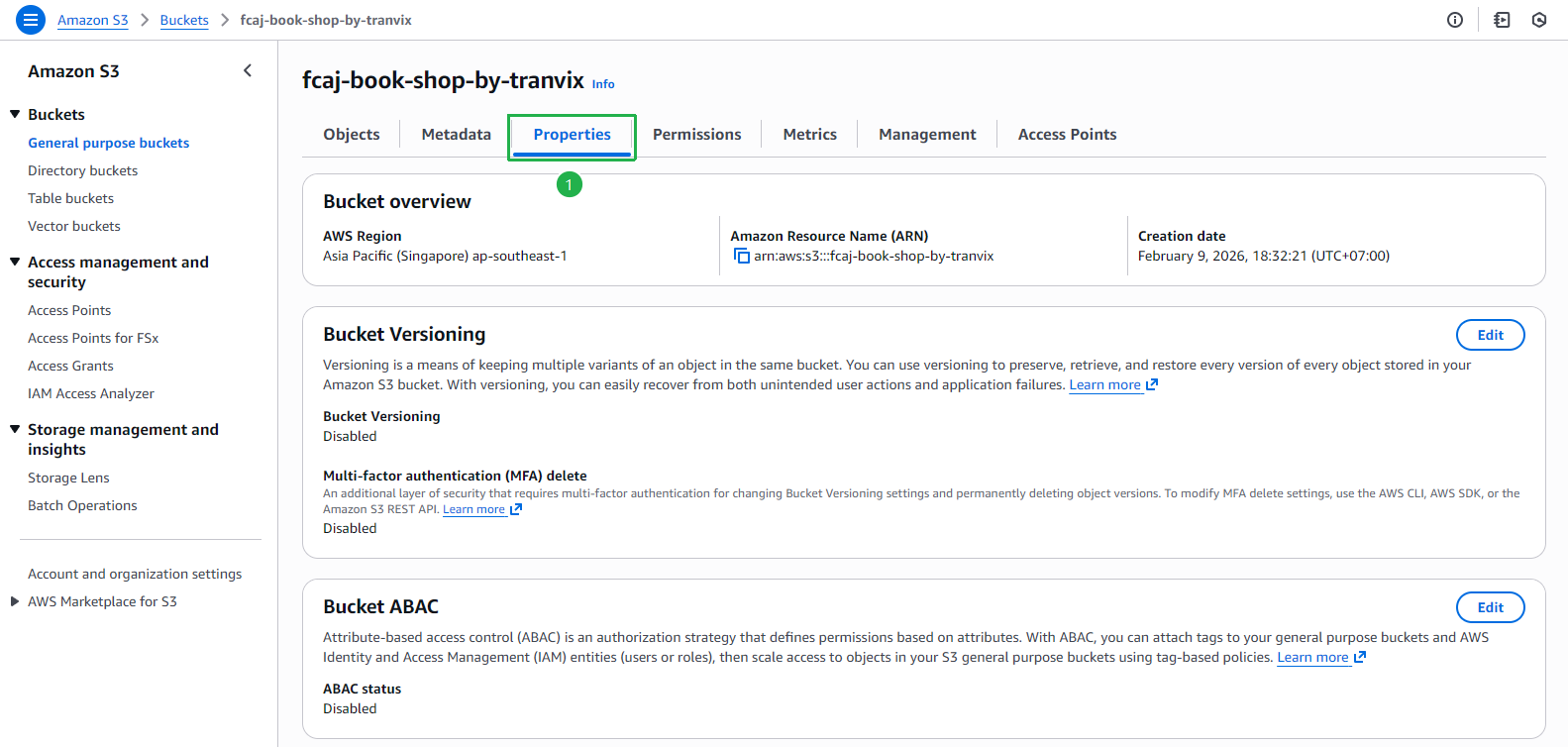
Open Amazon S3 console.
- Search and confirm the bucket has been created successfully.
- Click on the bucket to view its details.
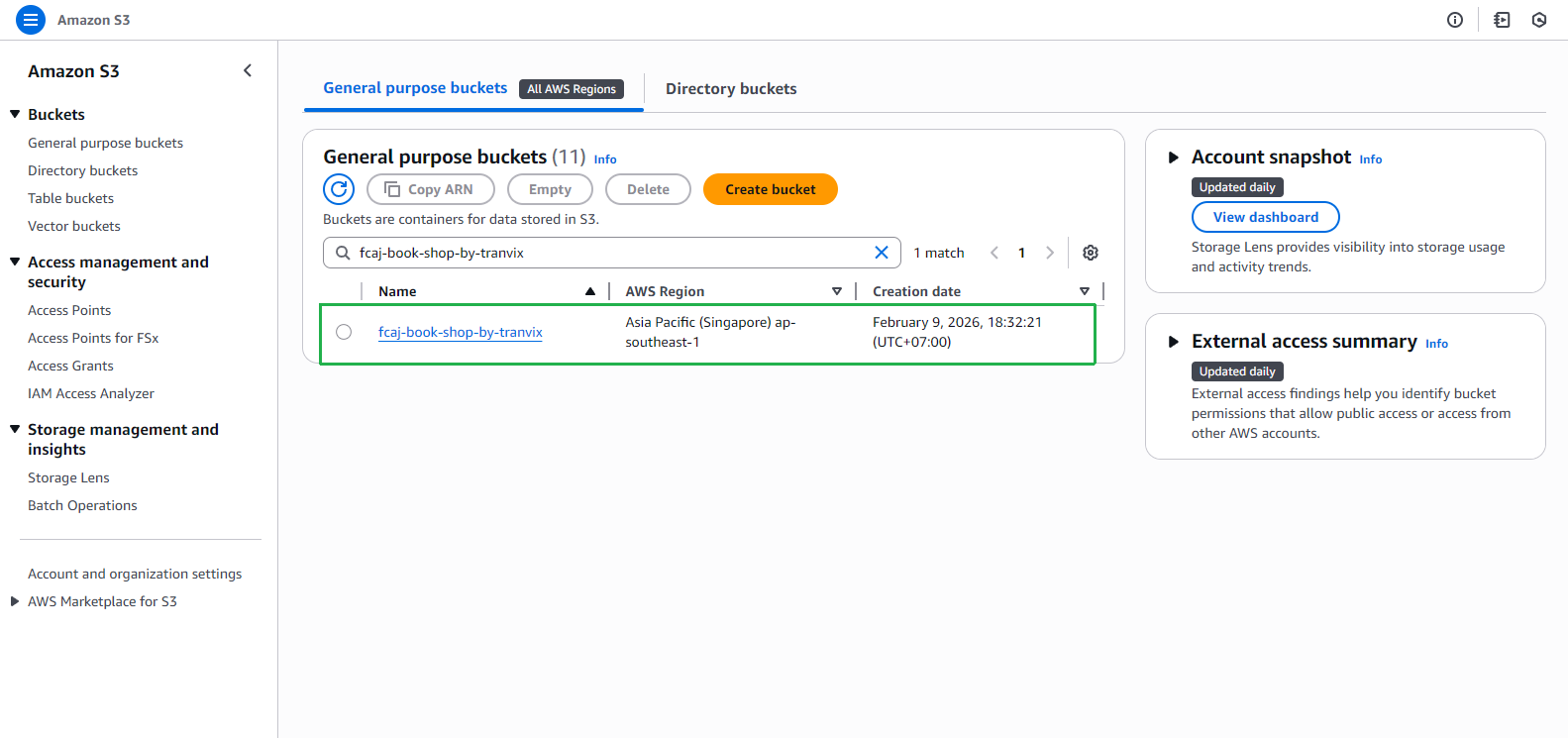
At the bucket detail page:
- Click on the Properties tab to view configuration information.
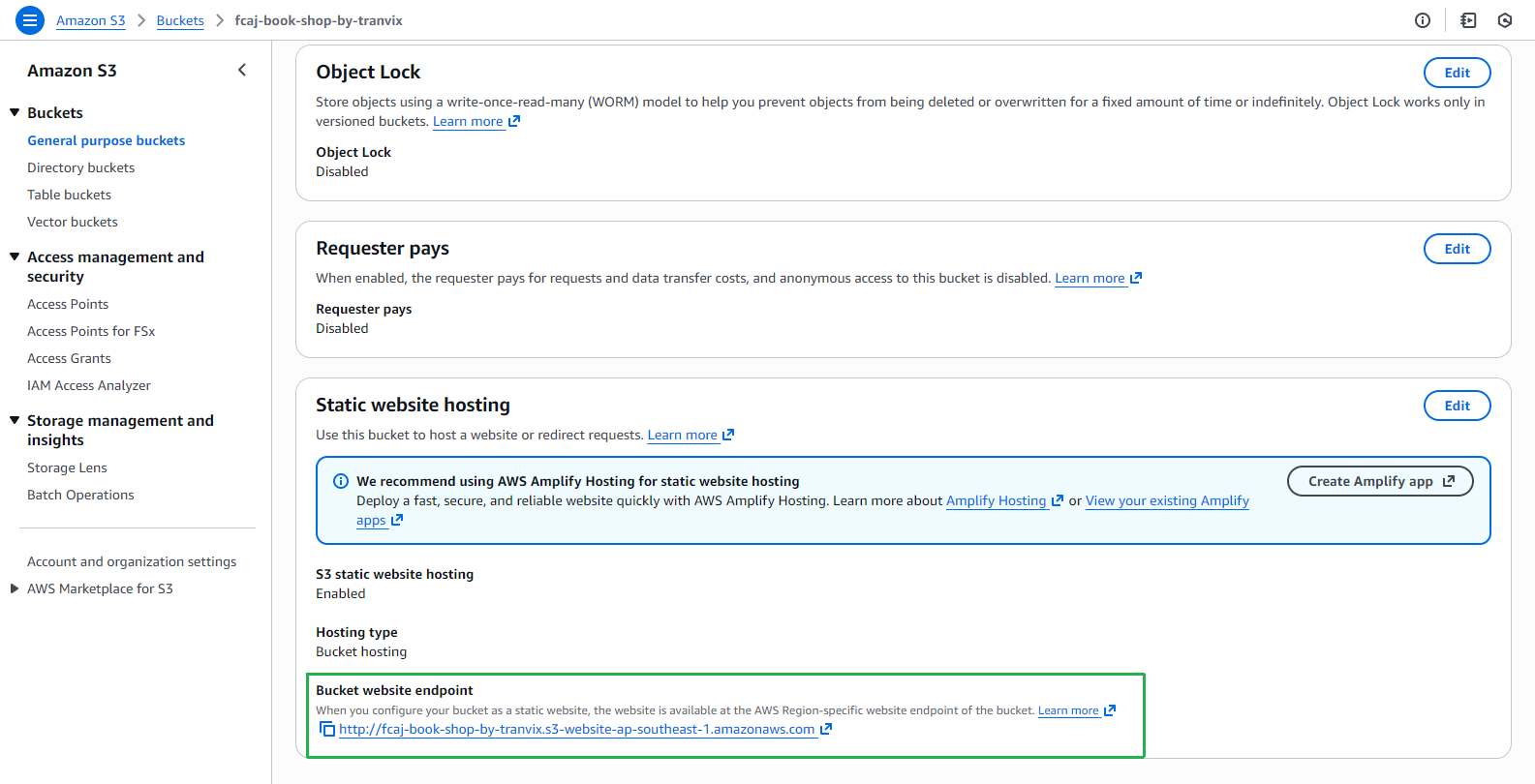
Scroll down to the Static website hosting section:
- Confirm the status is Enabled.
- Note the Bucket website endpoint — this is the URL to access the website after uploading the front-end.
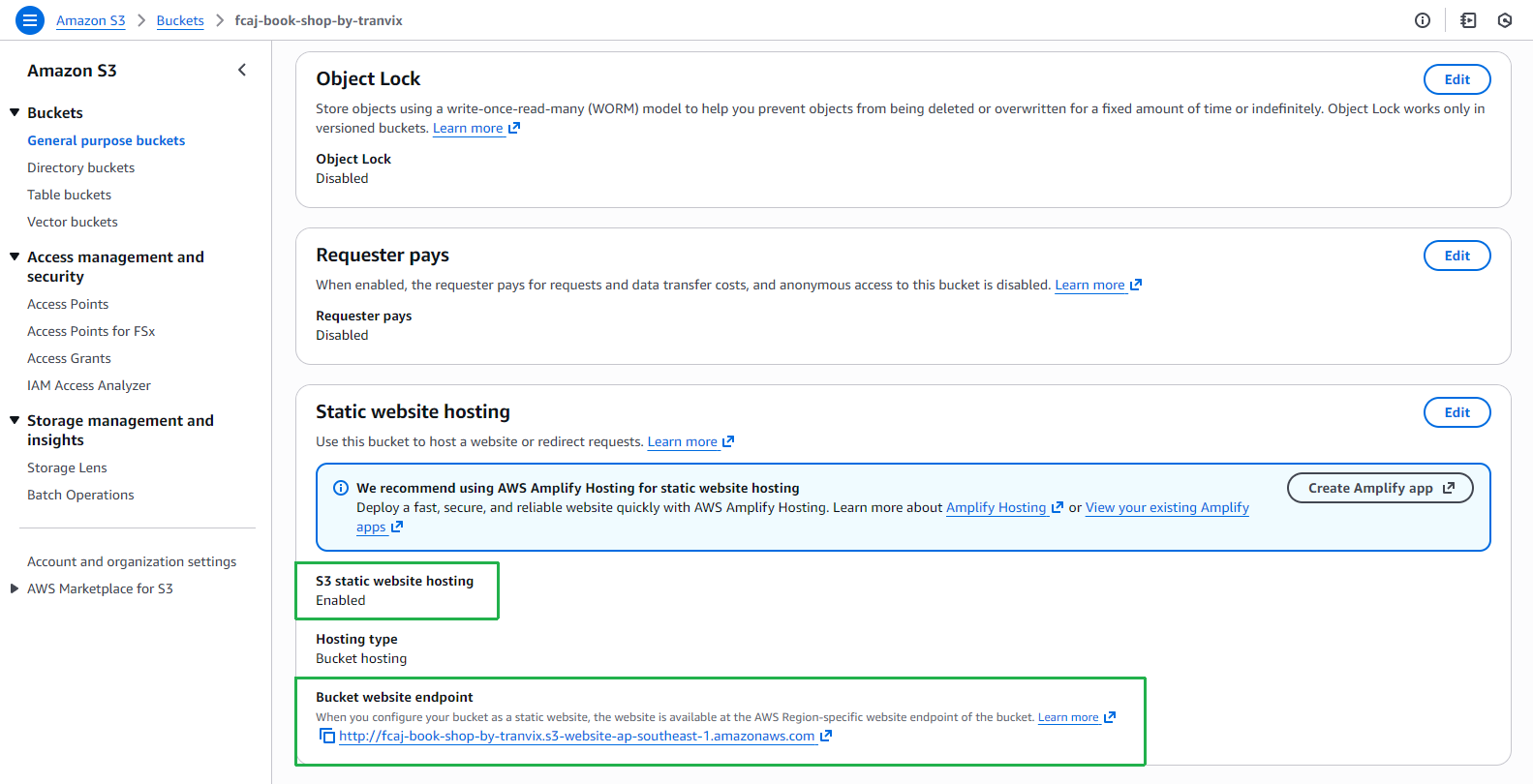
Make sure to save the Bucket website endpoint as you will need this URL to access the front-end application after uploading.
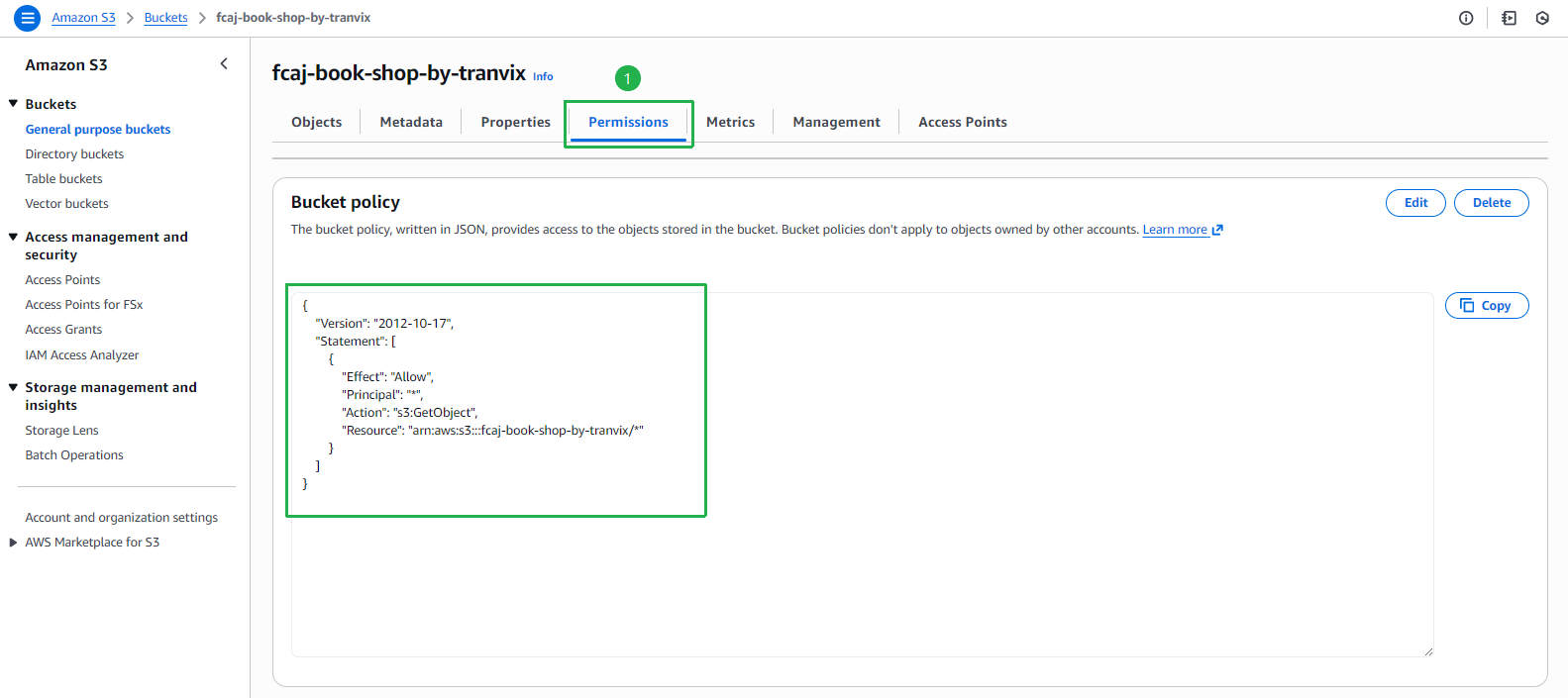
Click on the Permissions tab:
- Verify the Bucket policy has been automatically added by CloudFormation.
- The policy allows
s3:GetObjectwithPrincipal: "*", meaning everyone can read the files in the bucket.
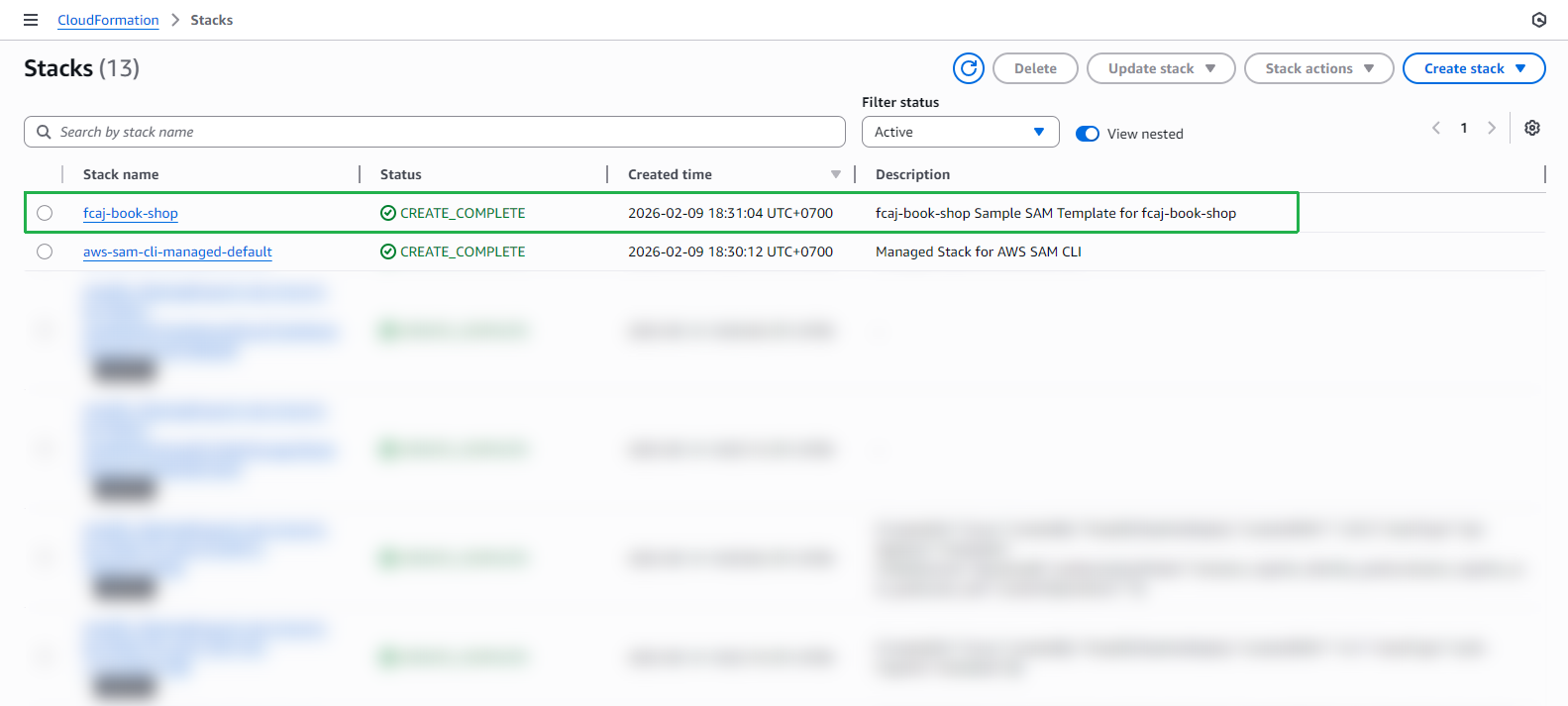
Open the CloudFormation console to check the stacks:
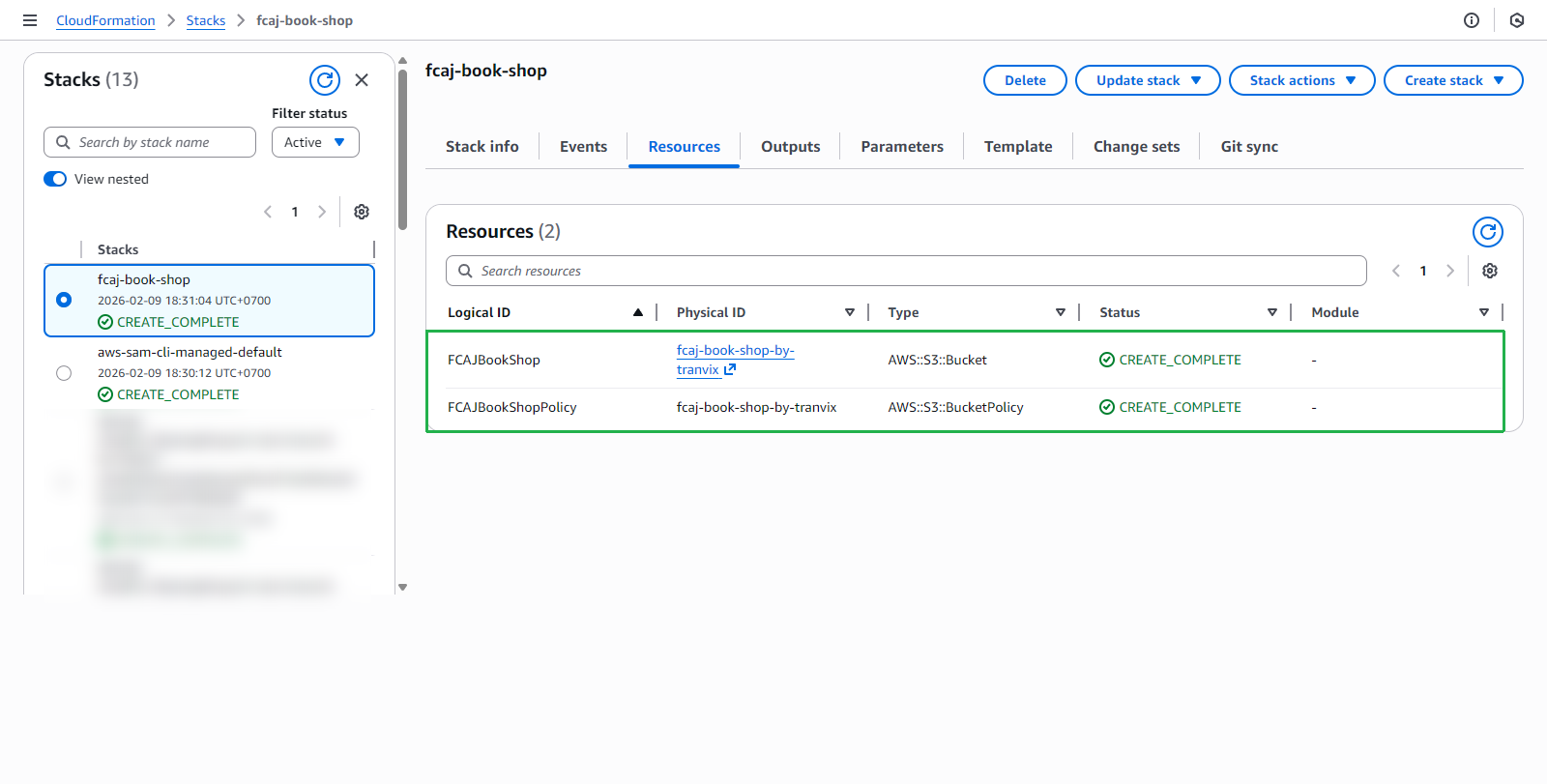
- The fcaj-book-shop stack has the status CREATE_COMPLETE.
Click on the fcaj-book-shop stack, switch to the Resources tab:
- View the resources created by CloudFormation: FCAJBookShop (S3 Bucket) and FCAJBookShopPolicy (Bucket Policy).
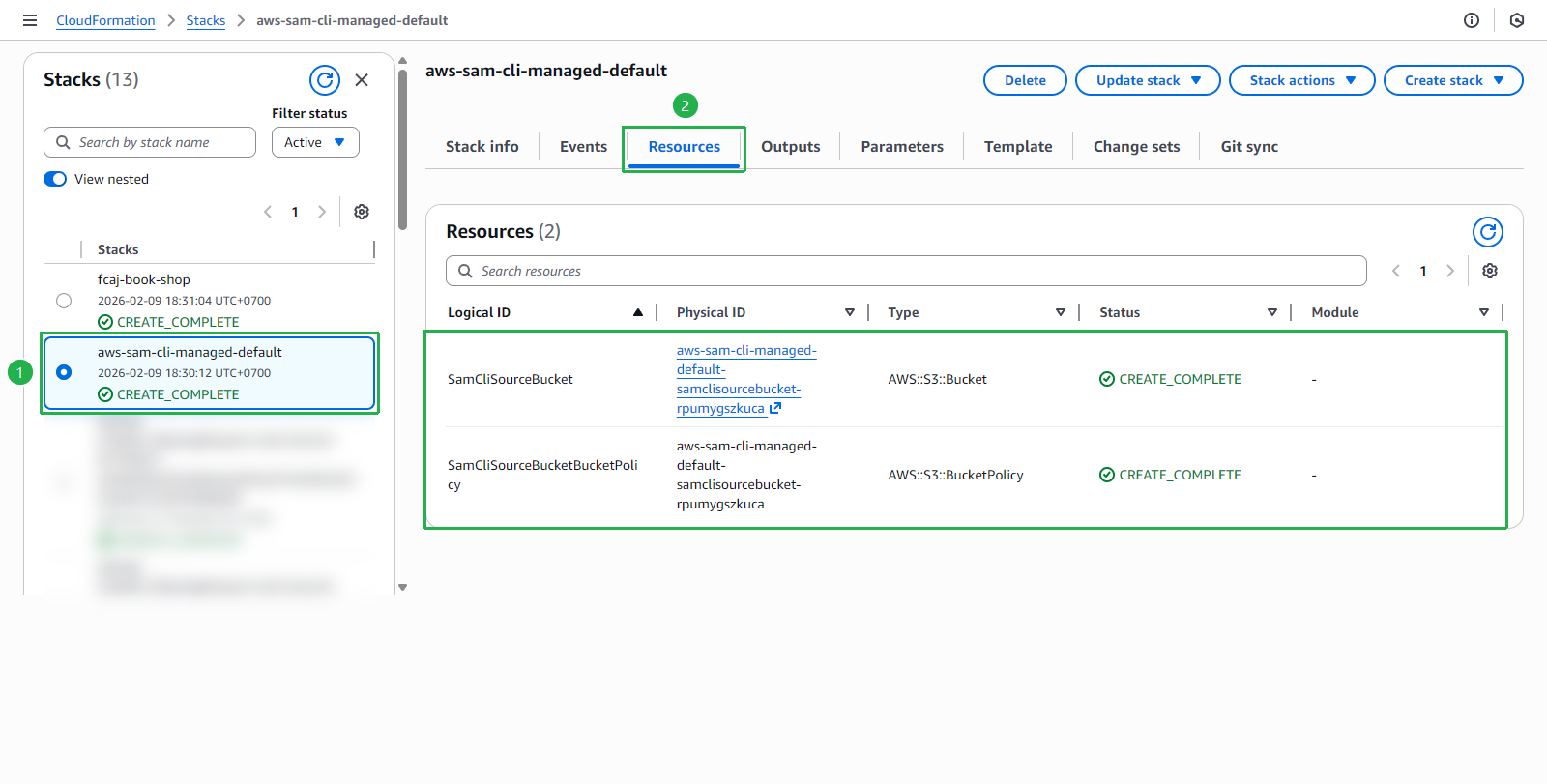
Click on the aws-sam-cli-managed-default stack to view the resources automatically created by SAM CLI:
- SamCliSourceBucket: Bucket used to store deployment artifacts.
- SamCliSourceBucketBucketPolicy: Policy for that bucket.
Upload Front-end to S3
Download the fcj-serverless-frontend source code to your device:
git clone https://github.com/tranvix0910/FCAJ_Workshop-Serverless.git
cd FCAJ_Workshop-Serverless
Make sure you have Node.js and npm installed on your machine before running the commands above. If not, please refer to: https://nodejs.org/
Install dependencies. Since some packages in the project may be outdated, use the
--forceflag:npm install --force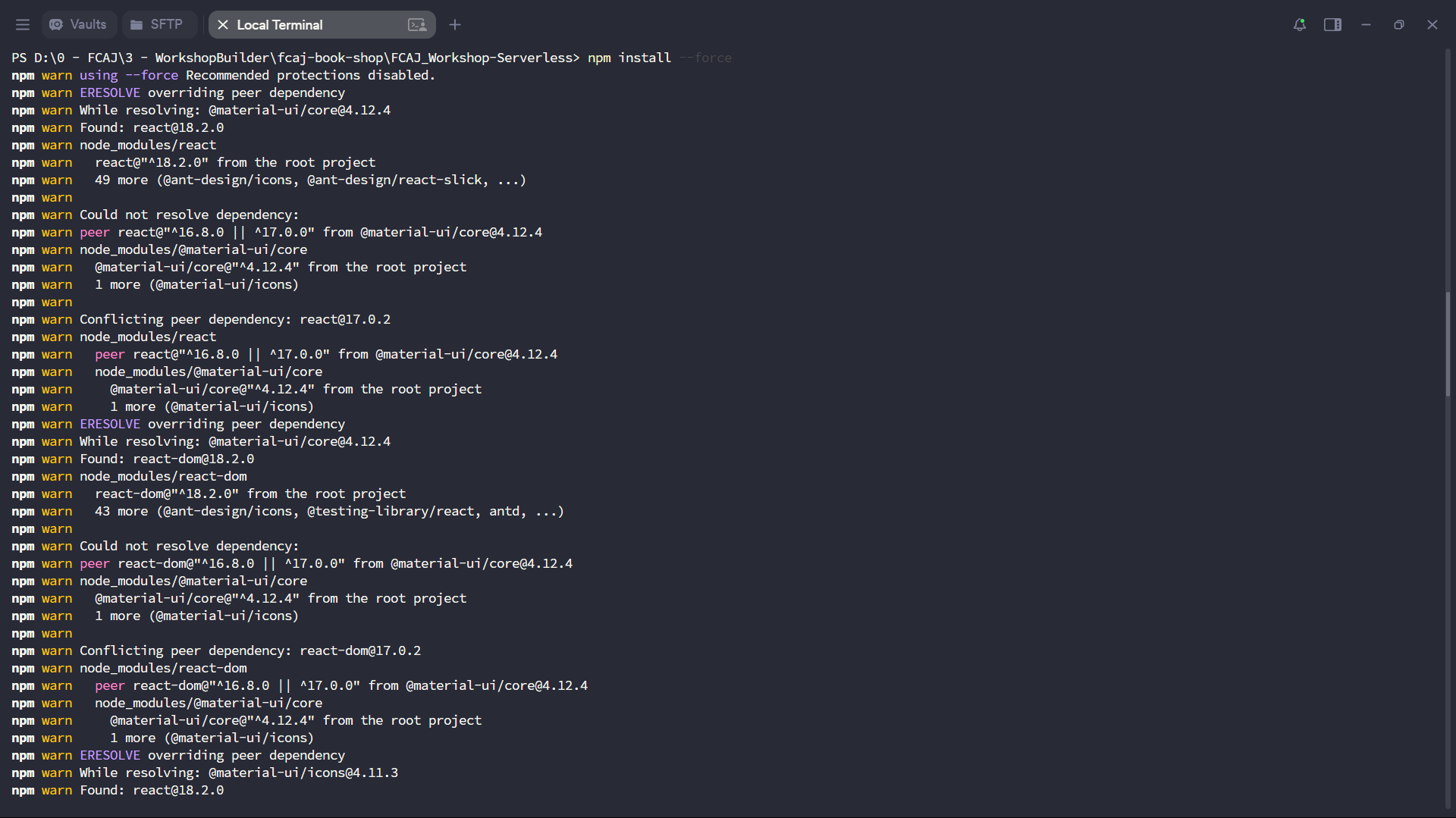
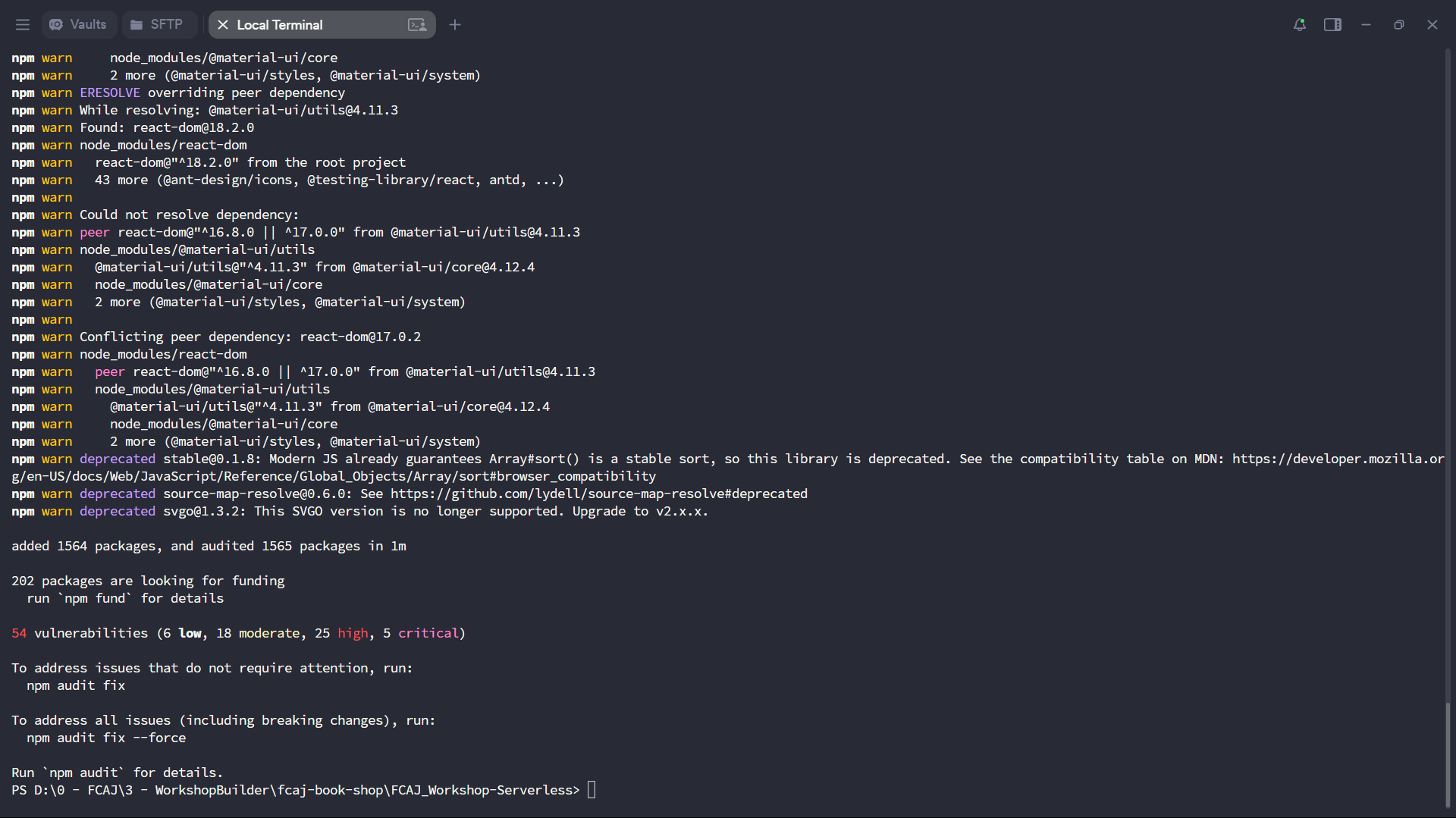
If npm install (without --force) fails due to dependency conflicts such as ERESOLVE overriding peer dependency, use npm install --force to force the installation despite outdated packages.
Build the front-end application:
npm run buildThe build may show some warnings — these can be safely ignored.
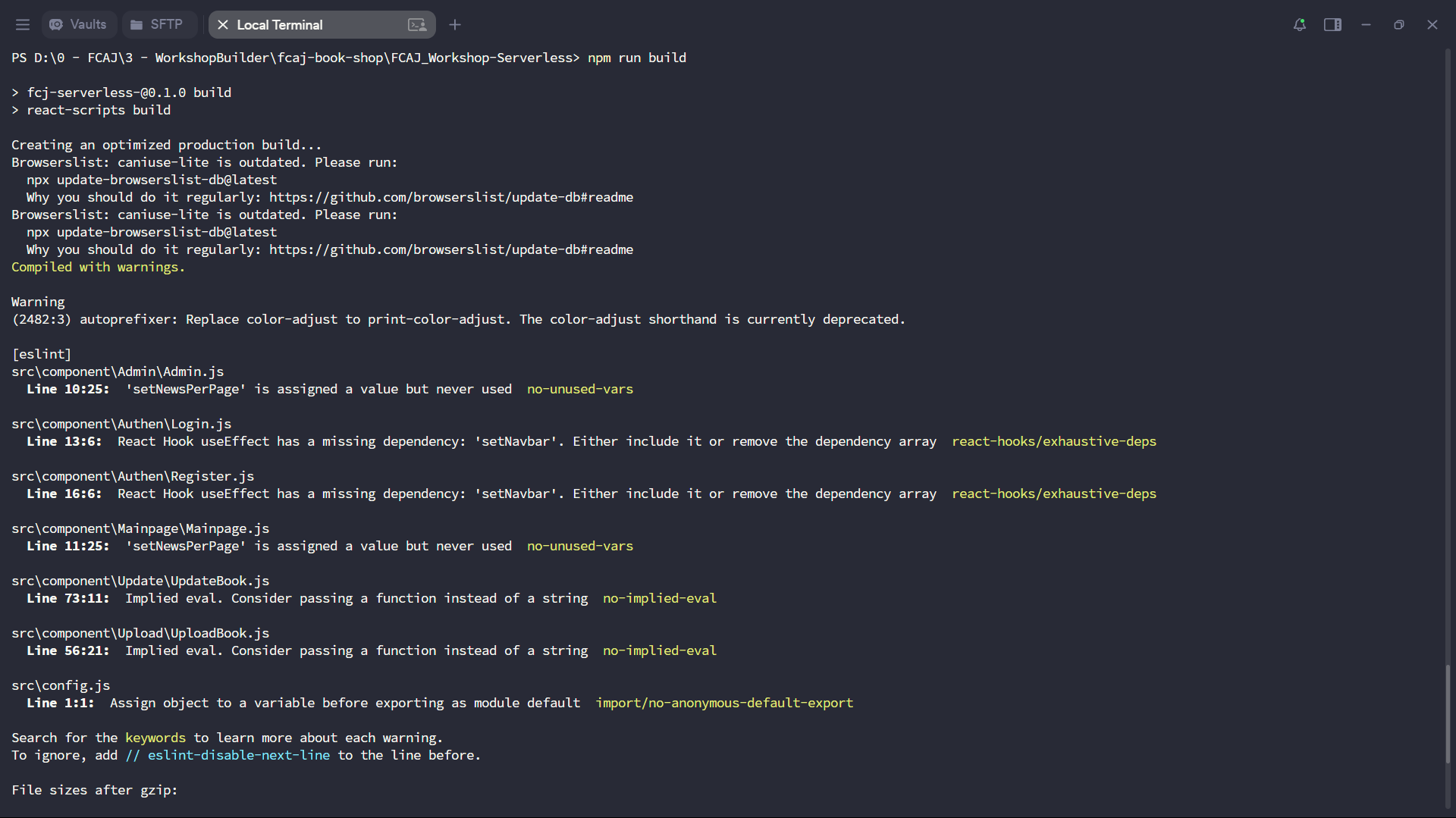
After the build completes, a build folder will be created. Upload it to the S3 bucket:
aws s3 cp build s3://fcaj-book-shop-by-myself --recursive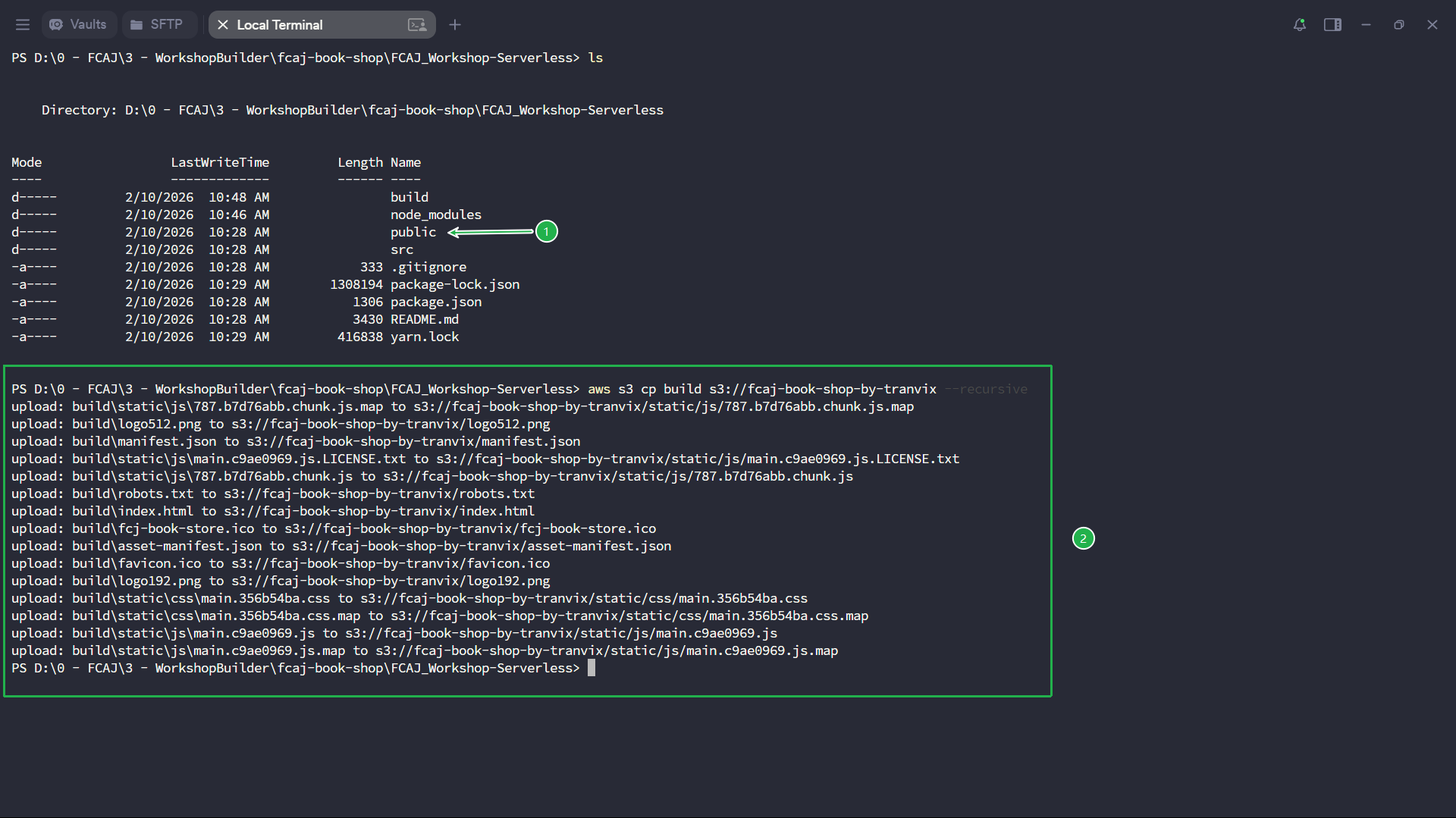
Replace fcaj-book-shop-by-myself with the actual bucket name you created in the previous step.
Verify the Deployment
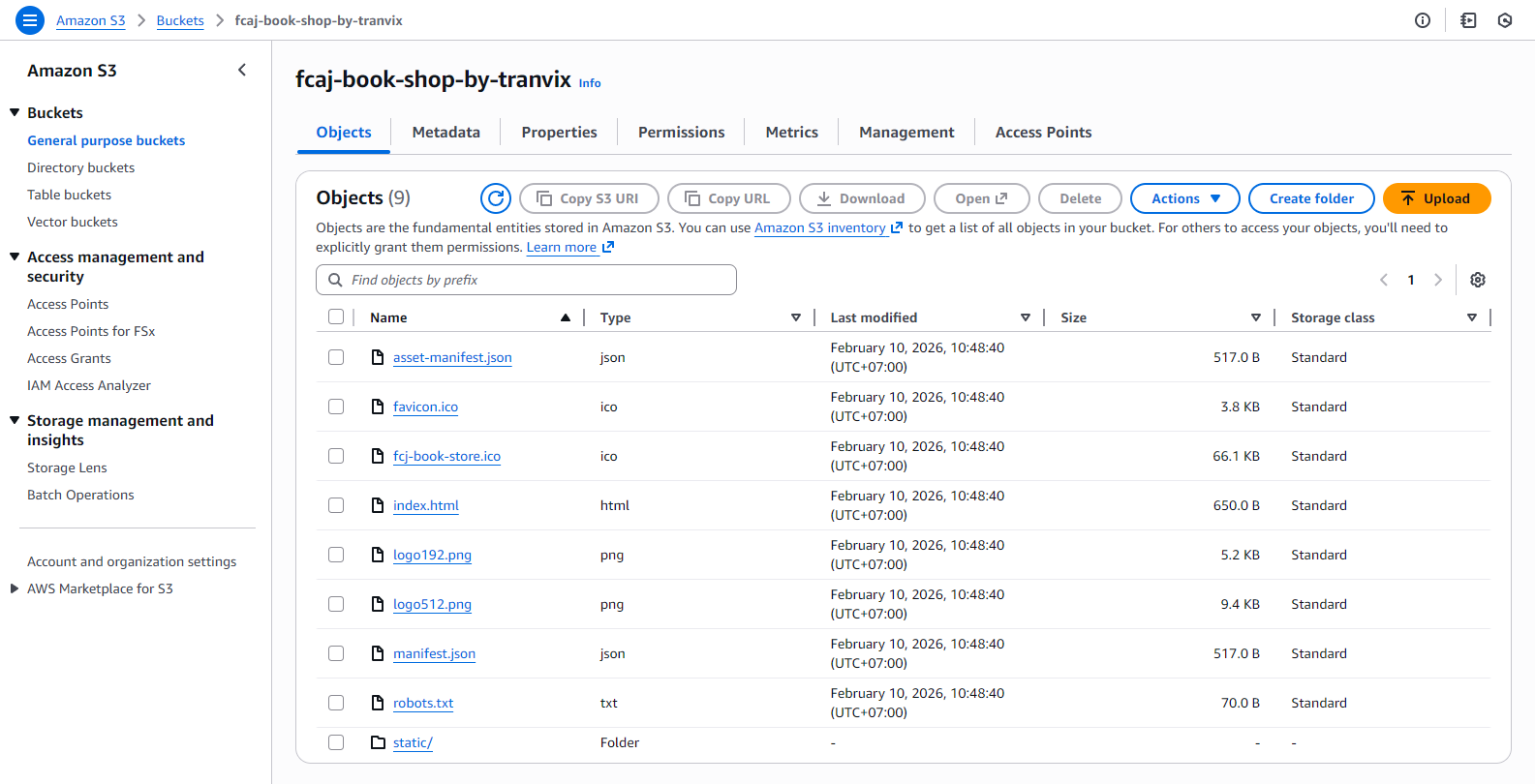
Open the Amazon S3 console, navigate to your bucket and check the Objects tab to confirm all files have been uploaded successfully.
Go to the Properties tab, scroll down to Static website hosting and copy the Bucket website endpoint.
Open the endpoint URL in your browser. You should see the FCJ Book Store website loaded successfully.
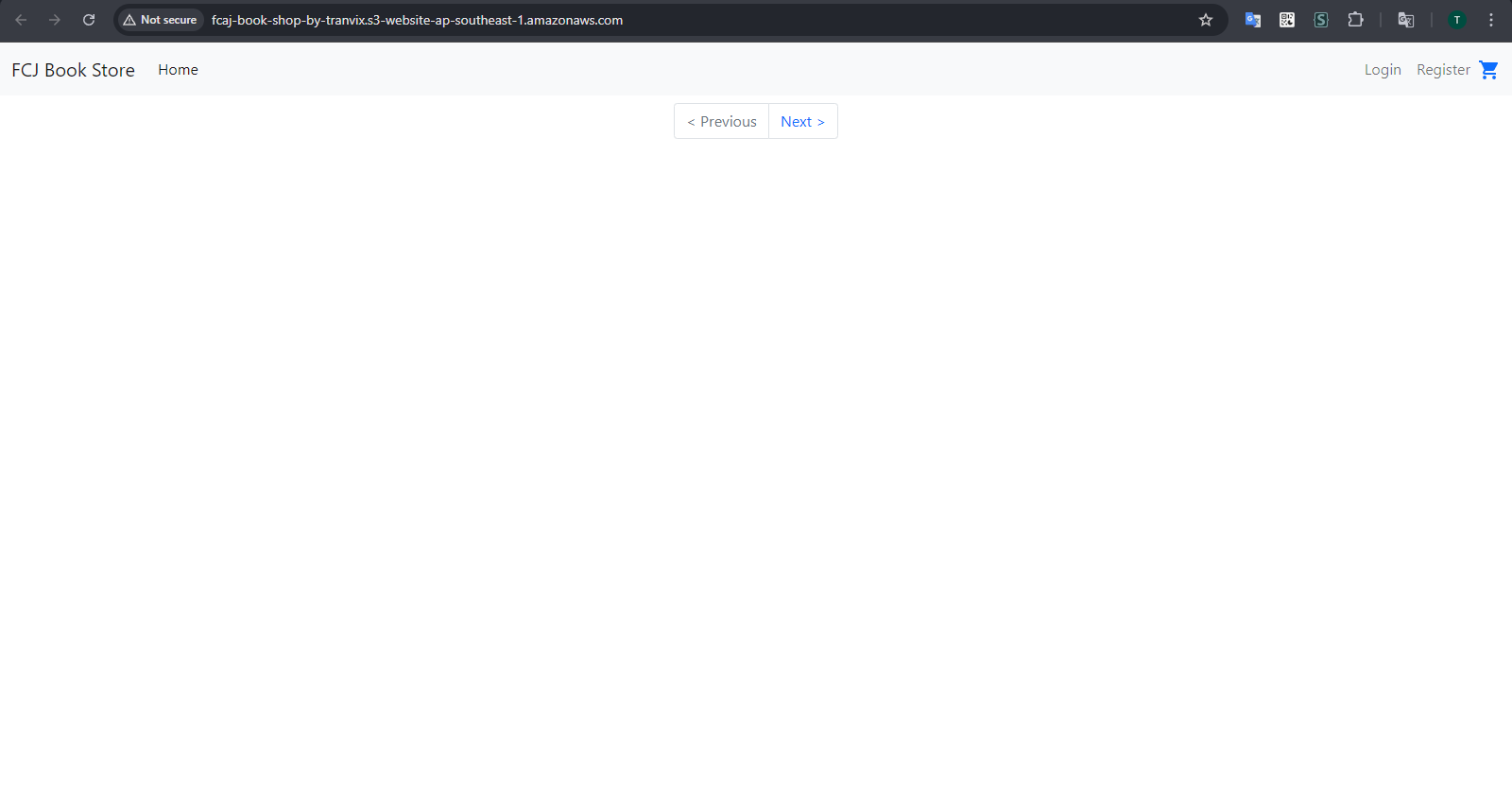
The website currently shows an empty page because we haven’t set up the backend (API Gateway + Lambda + DynamoDB) yet. We will complete this in the next sections.