Writing Lambda function
We will create a Lambda function that writes data to the DynamoDB table and uploads images to S3.
Edit SAM Template
This function requires two additional S3 buckets:
- BookImageShop - stores the original uploaded book images
- BookImageResizeShop - stores resized images for serving to the frontend, with a public bucket policy and CORS configuration
Open the template.yaml file in the fcaj-book-shop folder.
Add the following parameters under the
Parameterssection:bookImageShopBucketName: Type: String Default: book-image-shop-by-tranvix bookImageResizeShopBucketName: Type: String Default: book-image-resize-shop-by-tranvix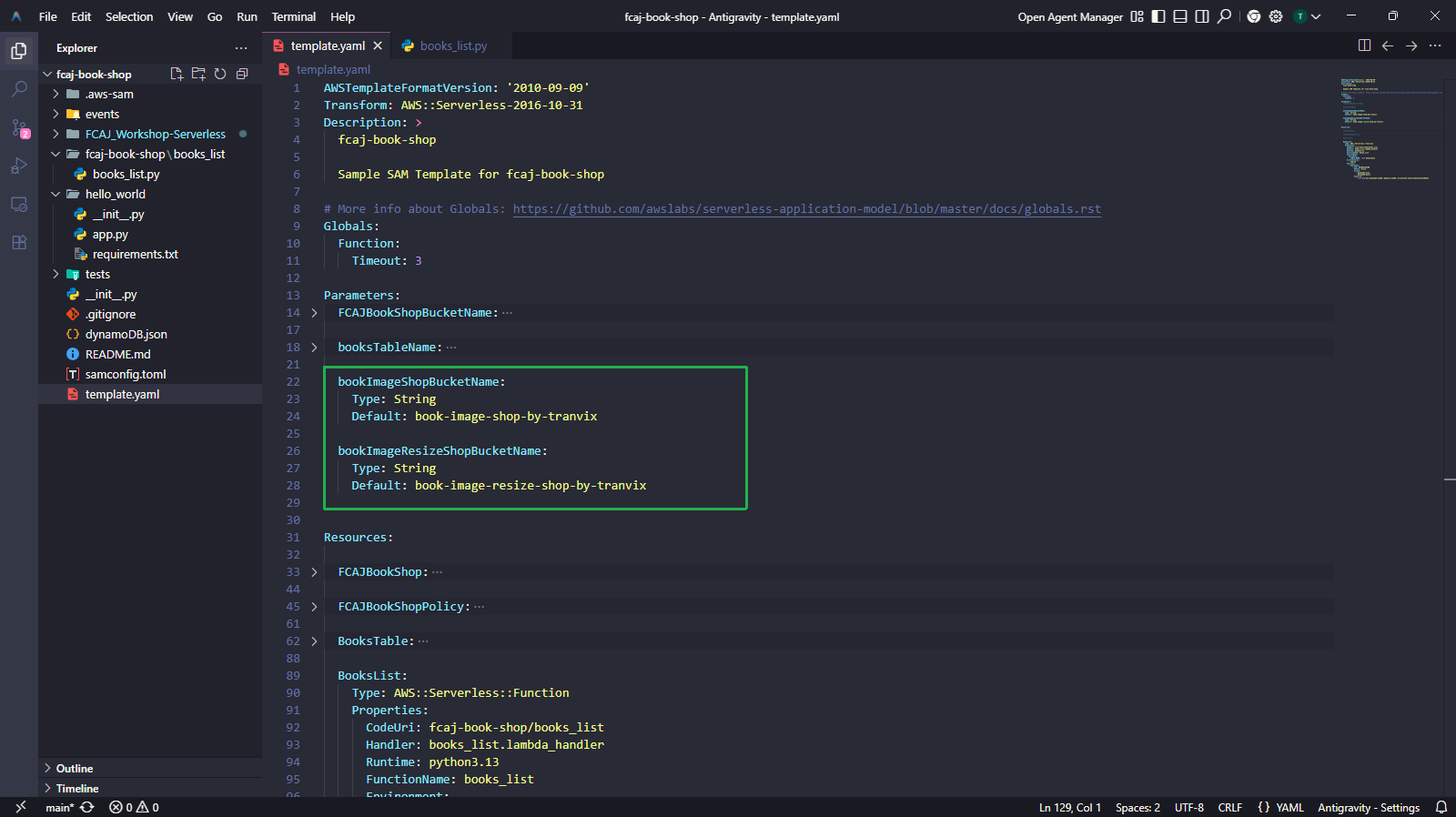
Add the S3 bucket resources under the
Resourcessection:BookImageShop: Type: AWS::S3::Bucket Properties: BucketName: !Ref bookImageShopBucketName PublicAccessBlockConfiguration: BlockPublicAcls: false BlockPublicPolicy: false IgnorePublicAcls: false RestrictPublicBuckets: false BookImageResizeShop: Type: AWS::S3::Bucket Properties: BucketName: !Ref bookImageResizeShopBucketName PublicAccessBlockConfiguration: BlockPublicAcls: false BlockPublicPolicy: false IgnorePublicAcls: false RestrictPublicBuckets: false CorsConfiguration: CorsRules: - AllowedHeaders: - "*" AllowedMethods: - GET - PUT - POST - DELETE AllowedOrigins: - "*"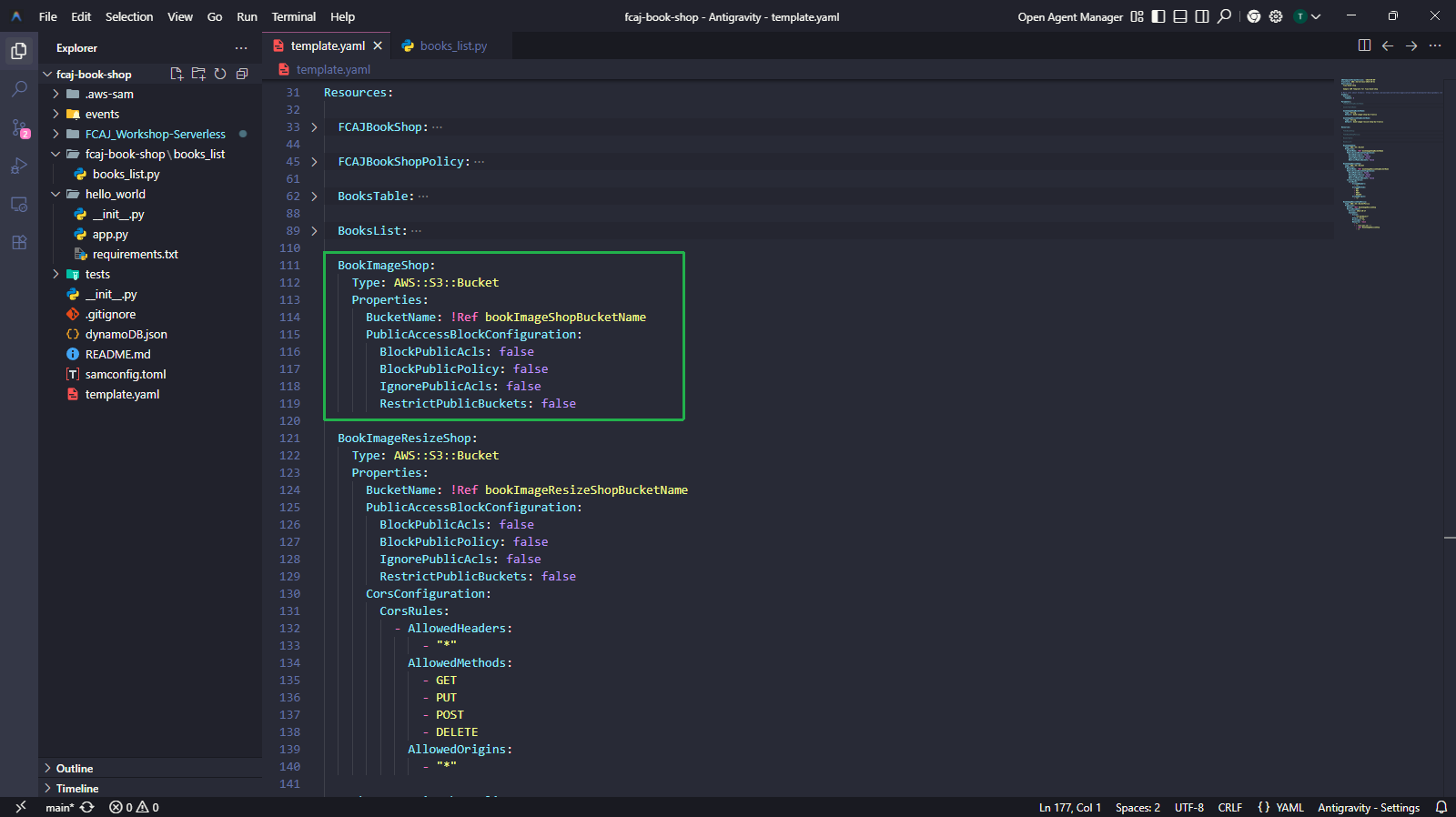
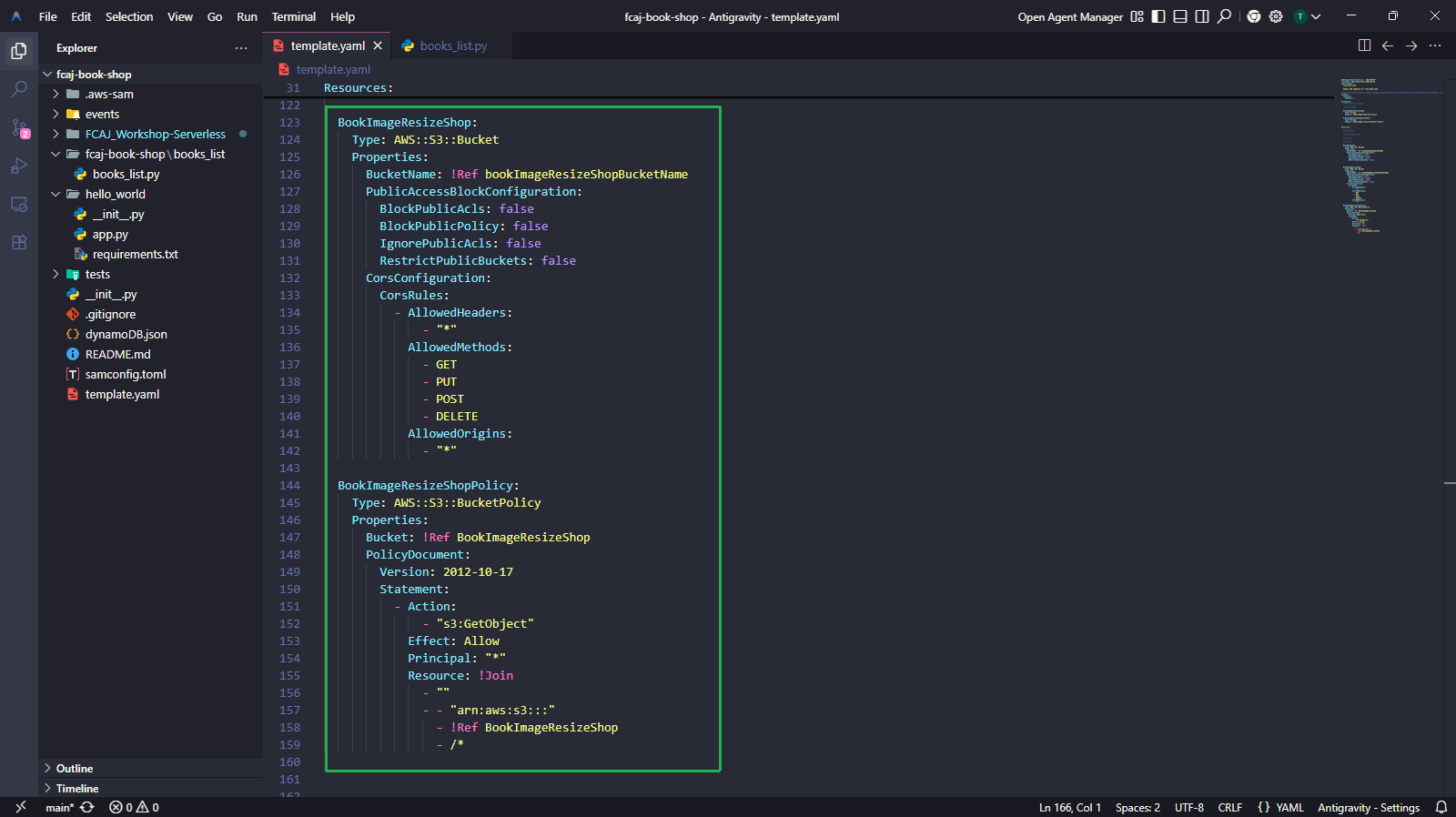
Add the bucket policy for the resize bucket and the BookCreate Lambda function:
BookImageResizeShopPolicy:
  Type: AWS::S3::BucketPolicy
  Properties:
    Bucket: !Ref BookImageResizeShop
    PolicyDocument:
      Version: 2012-10-17
      Statement:
        - Action:
            - "s3:GetObject"
          Effect: Allow
          Principal: "*"
          Resource: !Join
            - ""
            - - "arn:aws:s3:::"
              - !Ref BookImageResizeShop
              - /*
Add the BookCreate Lambda function resource:
BookCreate:
  Type: AWS::Serverless::Function
  Properties:
    CodeUri: fcaj-book-shop/book_create
    Handler: book_create.lambda_handler
    Runtime: python3.13
    Environment:
      Variables:
        BUCKET_NAME: !Ref BookImageShop
        BUCKET_RESIZE_NAME: !Ref BookImageResizeShop
        TABLE_NAME: !Ref BooksTable
    FunctionName: book_create
    Architectures:
      - x86_64
    Policies:
      - Statement:
          - Sid: BookCreateItem
            Effect: Allow
            Action:
              - dynamodb:PutItem
              - s3:PutObject
            Resource:
              - !Sub arn:aws:dynamodb:${AWS::Region}:${AWS::AccountId}:table/${booksTableName}
              - !Join
                - ""
                - - "arn:aws:s3:::"
                  - !Ref BookImageShop
                  - /*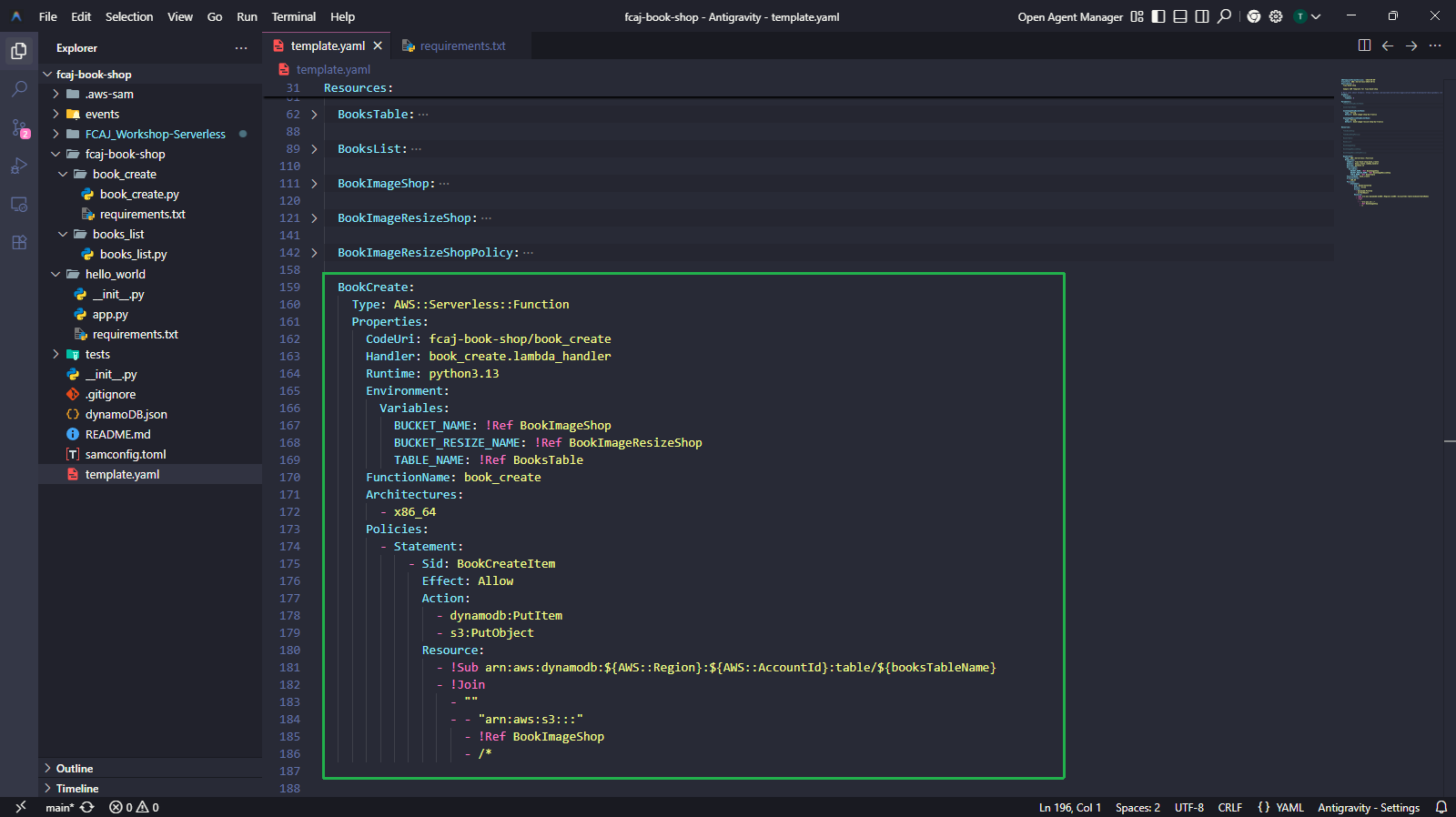
This resource defines a Lambda function named book_create that:
- Uses Python 3.13 runtime on x86_64 architecture
- Has environment variables for
BUCKET_NAME,BUCKET_RESIZE_NAME, andTABLE_NAME - Is granted dynamodb:PutItem permission on the Books table
- Is granted s3:PutObject permission on the BookImageShop bucket
Create Lambda Function Code
Create the following directory structure:
fcaj-book-shop ├── fcaj-book-shop │ ├── books_list │ │ └── books_list.py │ └── book_create │ ├── book_create.py │ └── requirements.txt └── template.yaml- Create the fcaj-book-shop/book_create folder inside the fcaj-book-shop directory.
- Create the book_create.py file and copy the following code into it:
import base64
from multipart import MultipartParser
from io import BytesIO
import boto3
import os

BUCKET = os.environ['BUCKET_NAME']
BUCKET_RESIZE = os.environ['BUCKET_RESIZE_NAME']
TABLE = os.environ['TABLE_NAME']

s3_client = boto3.client('s3')
dynamodb = boto3.resource('dynamodb')
table = dynamodb.Table(TABLE)

header_res = {
    "Content-Type": "application/json",
    "Access-Control-Allow-Origin": "*",
    "Access-Control-Allow-Methods": "OPTIONS,POST,GET,DELETE",
    "Access-Control-Allow-Headers": "Content-Type,X-Amz-Date,Authorization,X-Api-Key,X-Amz-Security-Token",
}

def parse_multipart(body, boundary):
    parser = MultipartParser(stream=body, boundary=boundary)

    fields = {}
    files = {}

    for part in parser:
        if part.filename:
            files[part.name] = {
                'file-name': part.filename,
                'content': part.raw
            }

        else:
            fields[part.name] = part.value

    return fields, files


def upload_to_s3(key, bucket, body):
    try:
        s3_client.put_object(Key=key, Bucket=bucket, Body=body)
    except Exception as e:
        print(f"Error uploading image to S3: {e}")
        raise Exception(f'Error uploading image to S3: {e}')


def create_new_item(table, item):
    try:
        table.put_item(Item=item)
    except Exception as e:
        print(f"Error creating new item in DynamoDB table: {e}")
        raise Exception(f'Error creating new item in DynamoDB table: {e}')


def lambda_handler(event, context):
    content_type = event['headers'].get(
        'Content-Type', '') or event['headers'].get('content-type', '')

    try:
        body = event['body']

        if event['isBase64Encoded']:
            body = BytesIO(base64.b64decode(body))

        boundary = content_type.split("boundary=")[1]

        fields, files = parse_multipart(body, boundary)

        # Upload image to s3
        file_name = files['image']['file-name']
        file_content = files['image']['content']

        upload_to_s3(file_name, BUCKET, file_content)
        s3_url = f'https://{BUCKET_RESIZE}.s3.amazonaws.com/{file_name}'

        # Create new item in DB
        item = {
            'id': fields.get('id', 0),
            'rv_id': 0,
            'name': fields.get('name', ''),
            'author': fields.get('author', ''),
            'price': fields.get('price', ''),
            'category': fields.get('category', ''),
            'description': fields.get('description', ''),
            'image': s3_url
        }

        create_new_item(table, item)

        return {
            "statusCode": 200,
            "headers": header_res,
            "body": "Successfully created item!",
        }

    except Exception as e:
        print(f"Error processing form data: {e}")
        raise Exception(f'Error processing form data: {e}')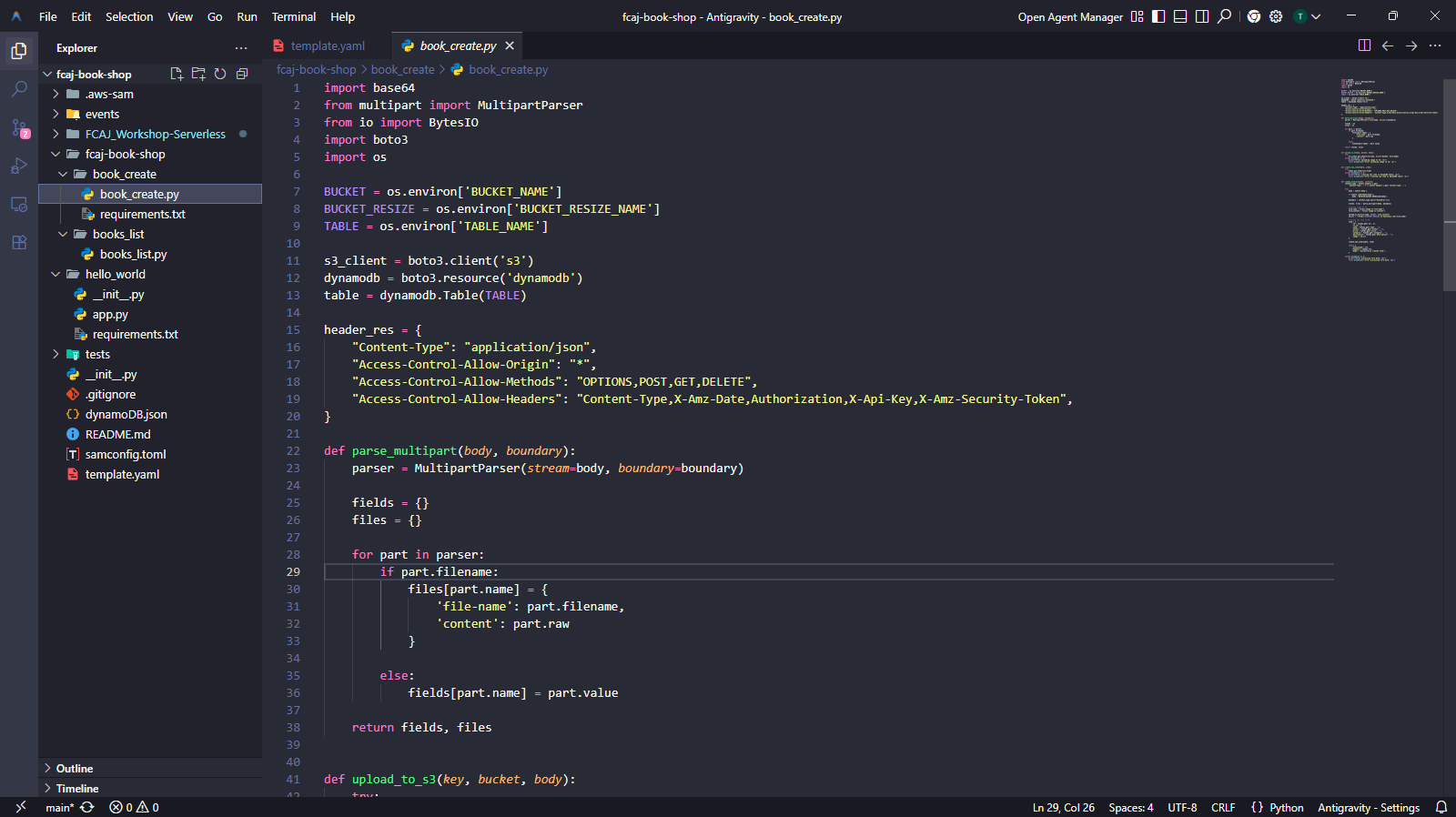
Create the requirements.txt file in the book_create folder with:
multipart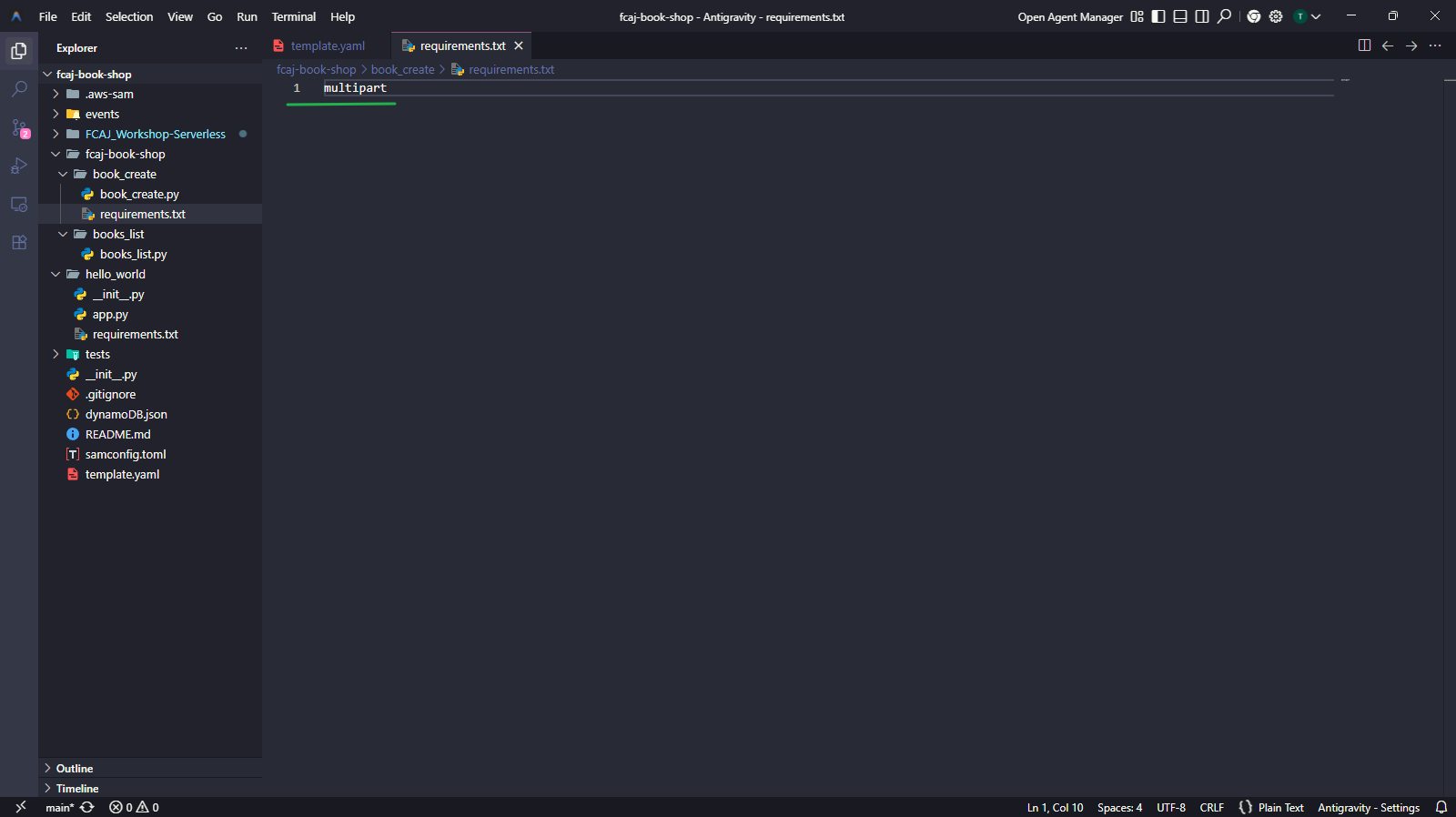
The multipart library is required for parsing multipart form data (file uploads) sent from the frontend. SAM will install this dependency during sam build.
Build and Deploy
Run the following commands to build and validate the SAM template:
sam validate
sam build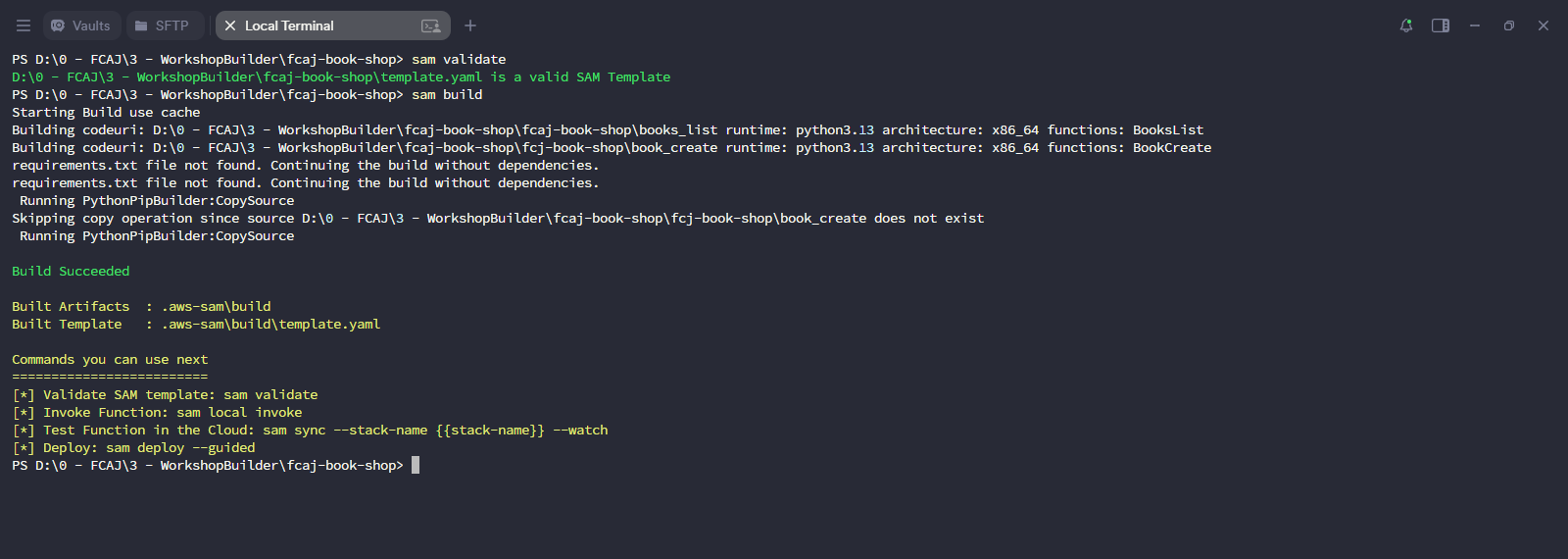
Deploy the updated stack:
sam deployThe changeset will show new resources being added:
BookCreateRole(AWS::IAM::Role)BookCreate(AWS::Lambda::Function)BookImageShop(AWS::S3::Bucket)BookImageResizeShop(AWS::S3::Bucket)BookImageResizeShopPolicy(AWS::S3::BucketPolicy)
Enter
yto confirm the deployment.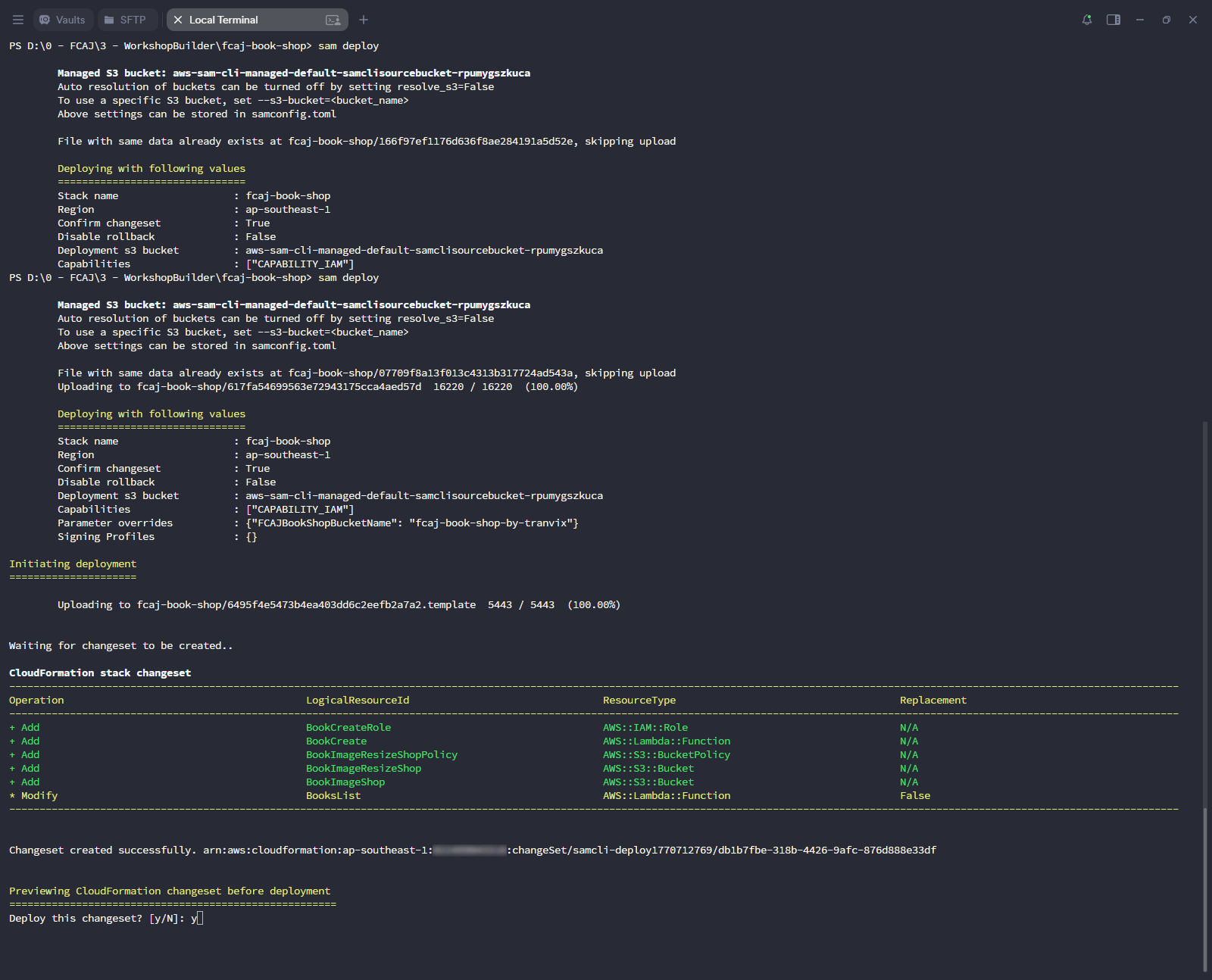
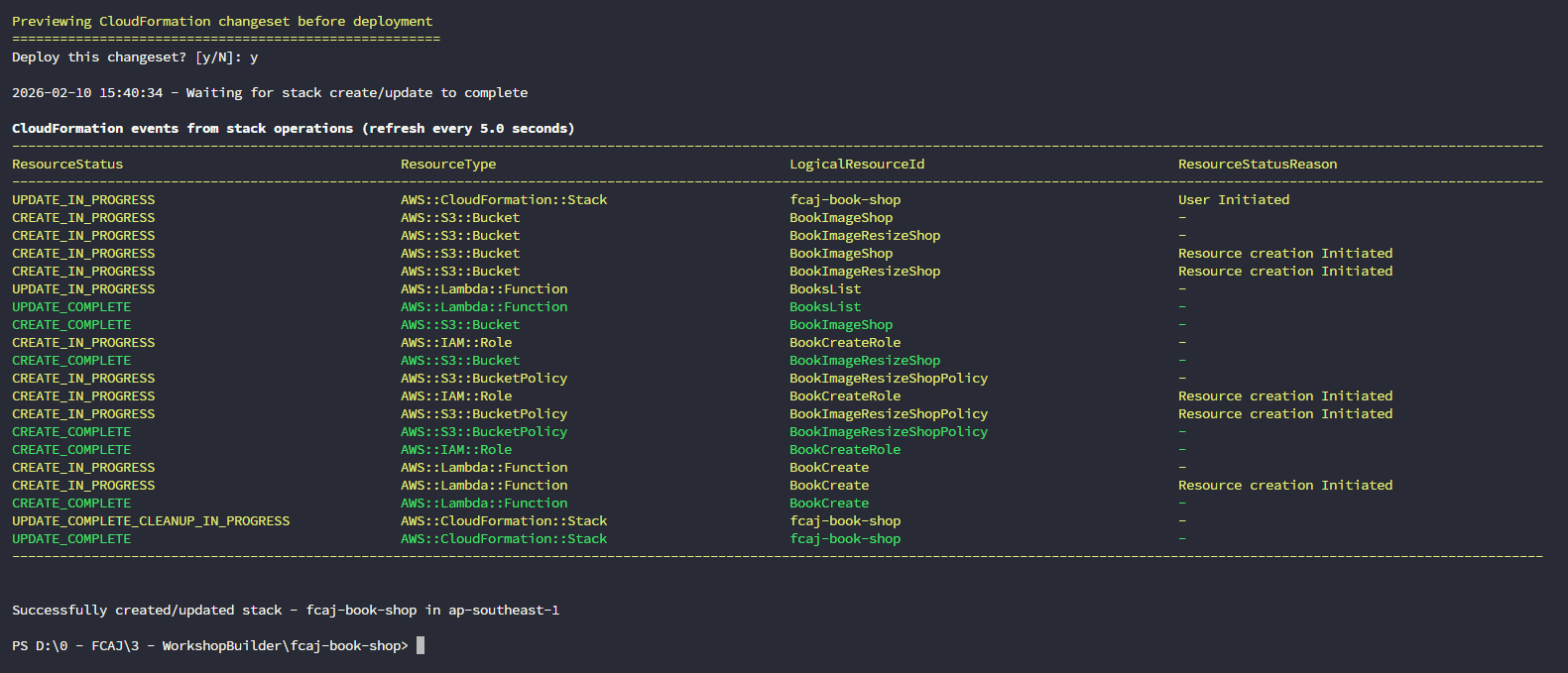
Wait for the deployment to complete. You should see Successfully created/updated stack.
Verify on AWS Console
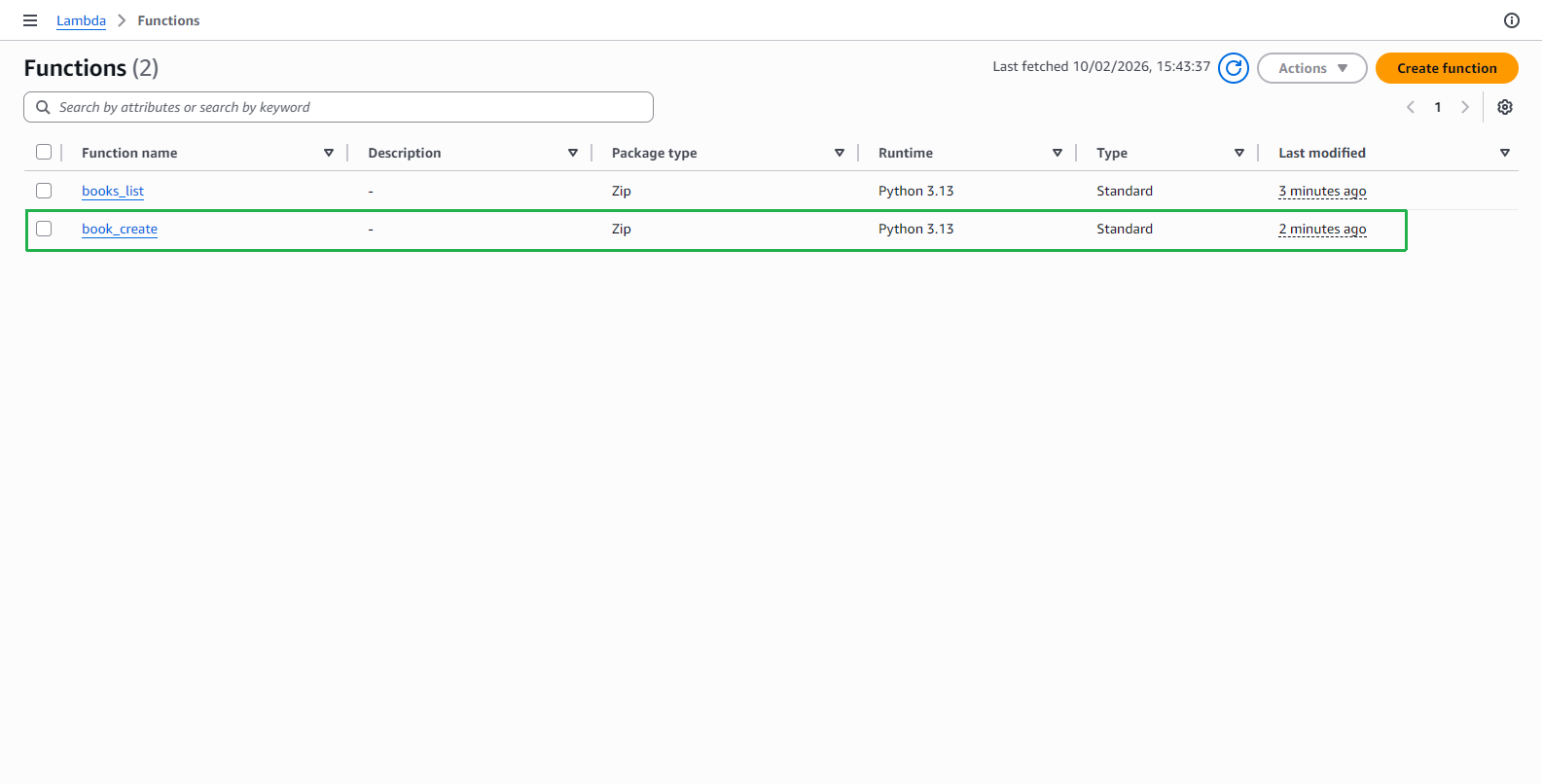
Open the Lambda console. You should now see both books_list and book_create functions.
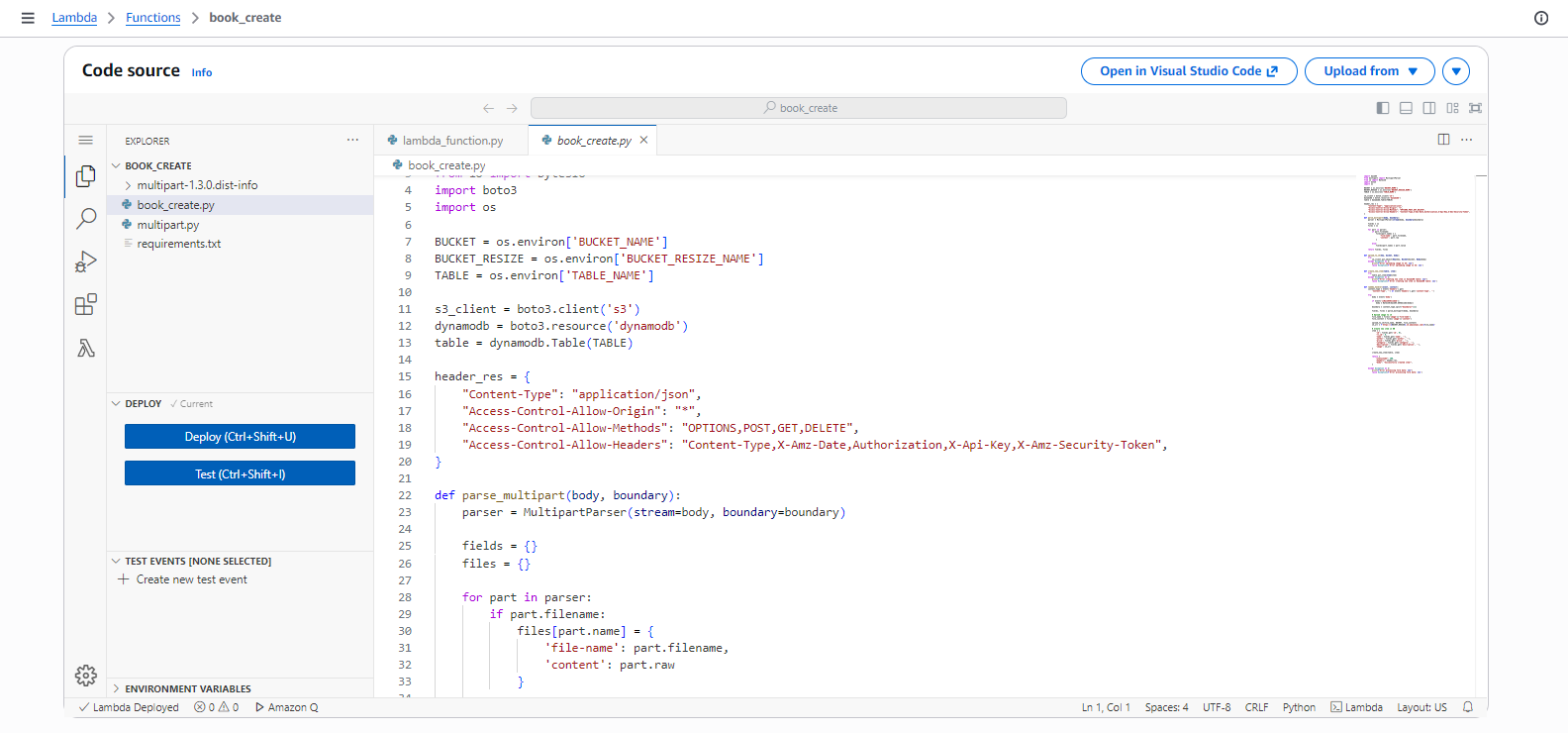
Click on the book_create function. Review the Code source section.
Review the Function overview section showing the function diagram.
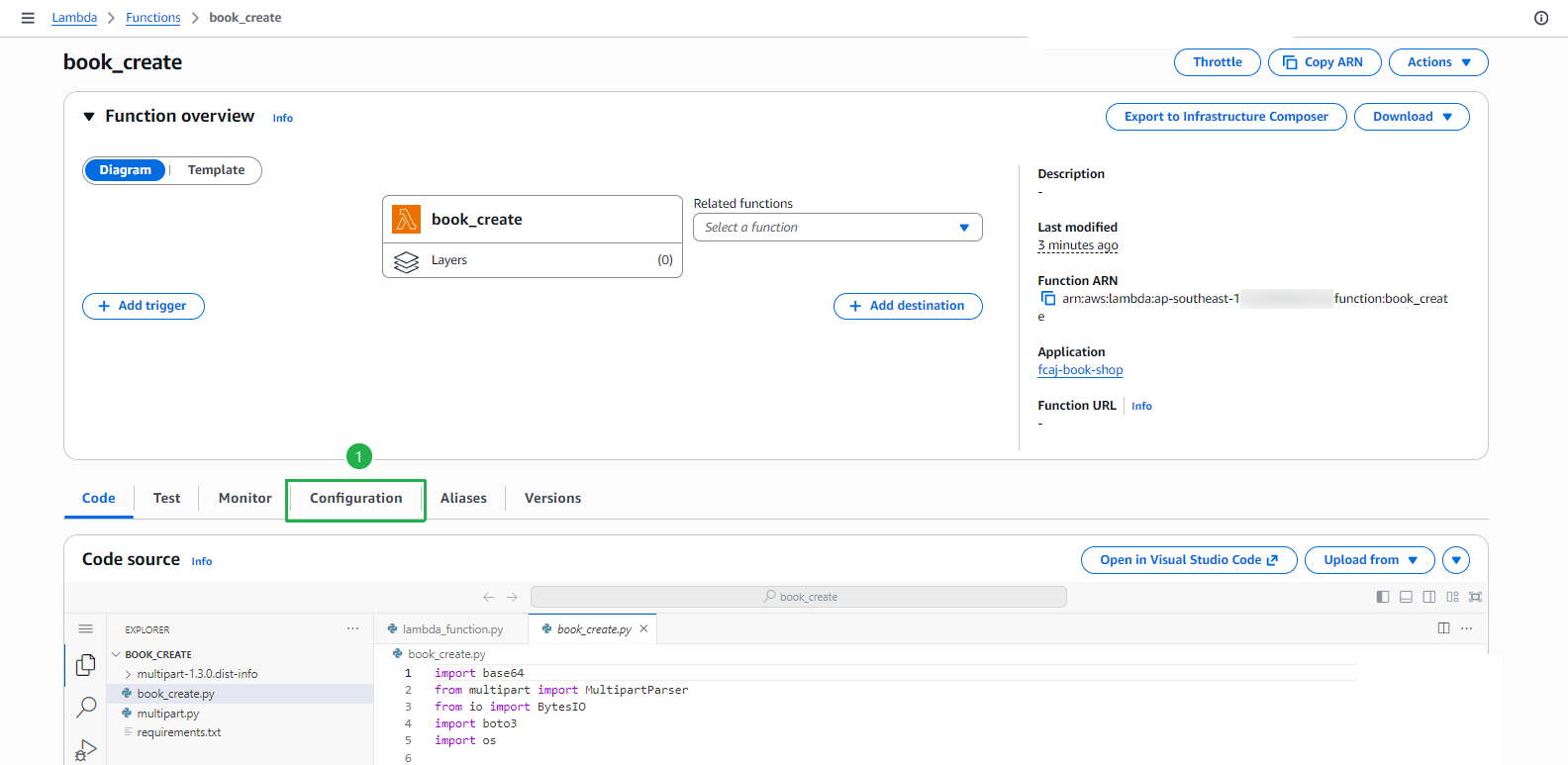
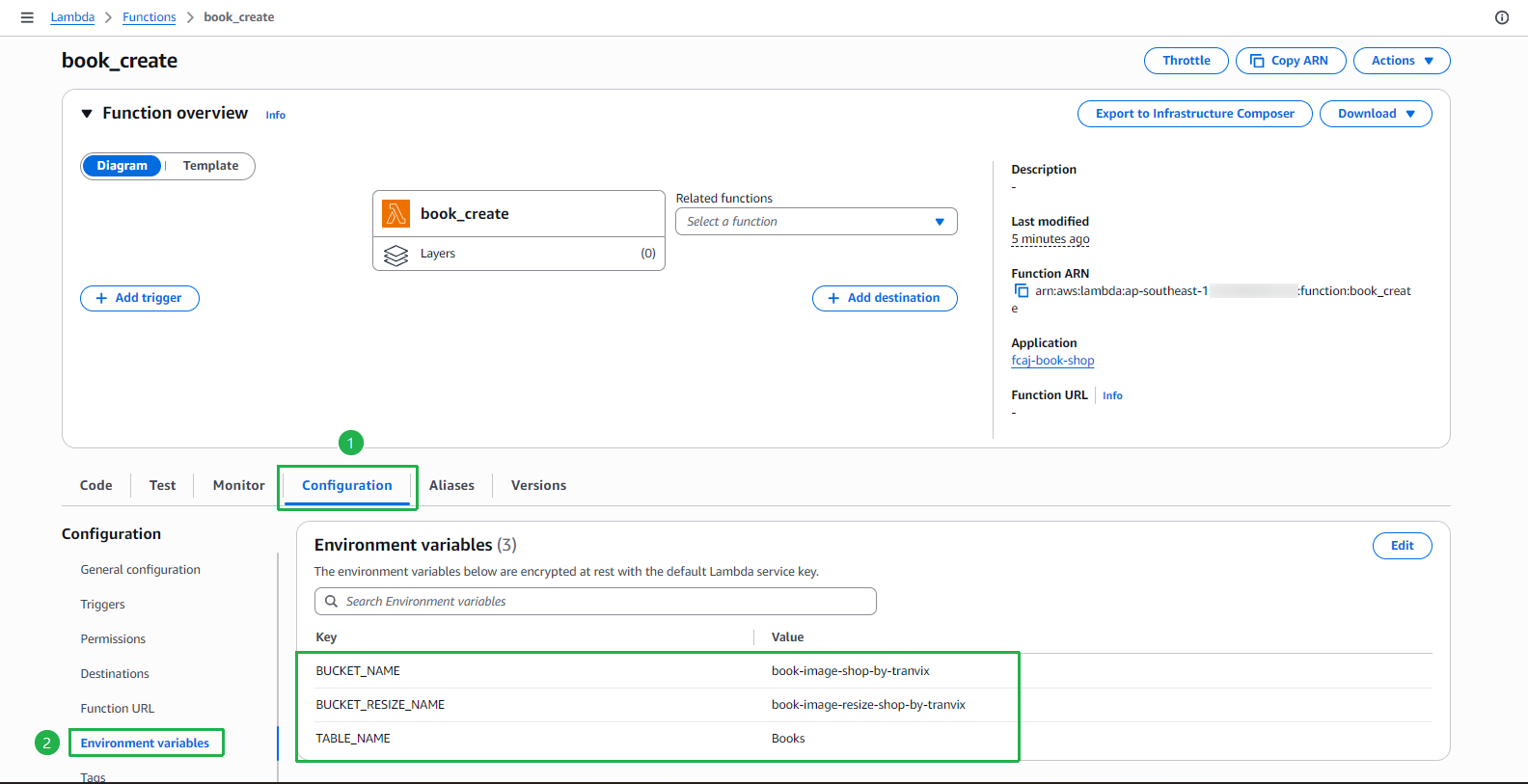
Click the Configuration tab, then select Environment variables. Verify that the 3 environment variables are set correctly:
BUCKET_NAME=book-image-shop-by-tranvixBUCKET_RESIZE_NAME=book-image-resize-shop-by-tranvixTABLE_NAME=Books
Select Permissions from the left menu. Click on the execution role name (e.g.,
fcaj-book-shop-BookCreateRole-...).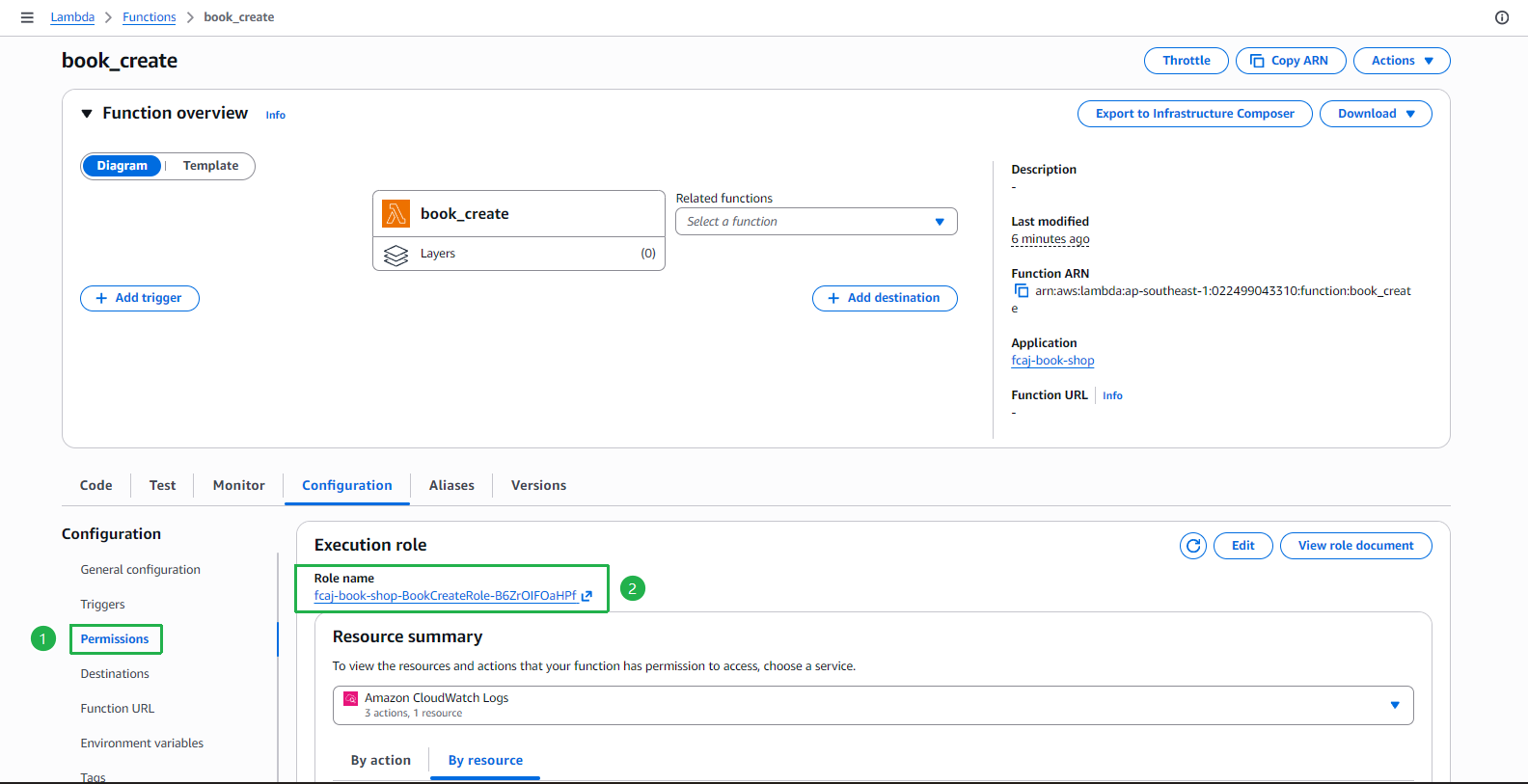
At the IAM Role page, check the Permissions policies section. You should see:
- AWSLambdaBasicExecutionRole (AWS managed) - for CloudWatch Logs
- BookCreateRolePolicy0 (Customer inline) - the custom policy we defined
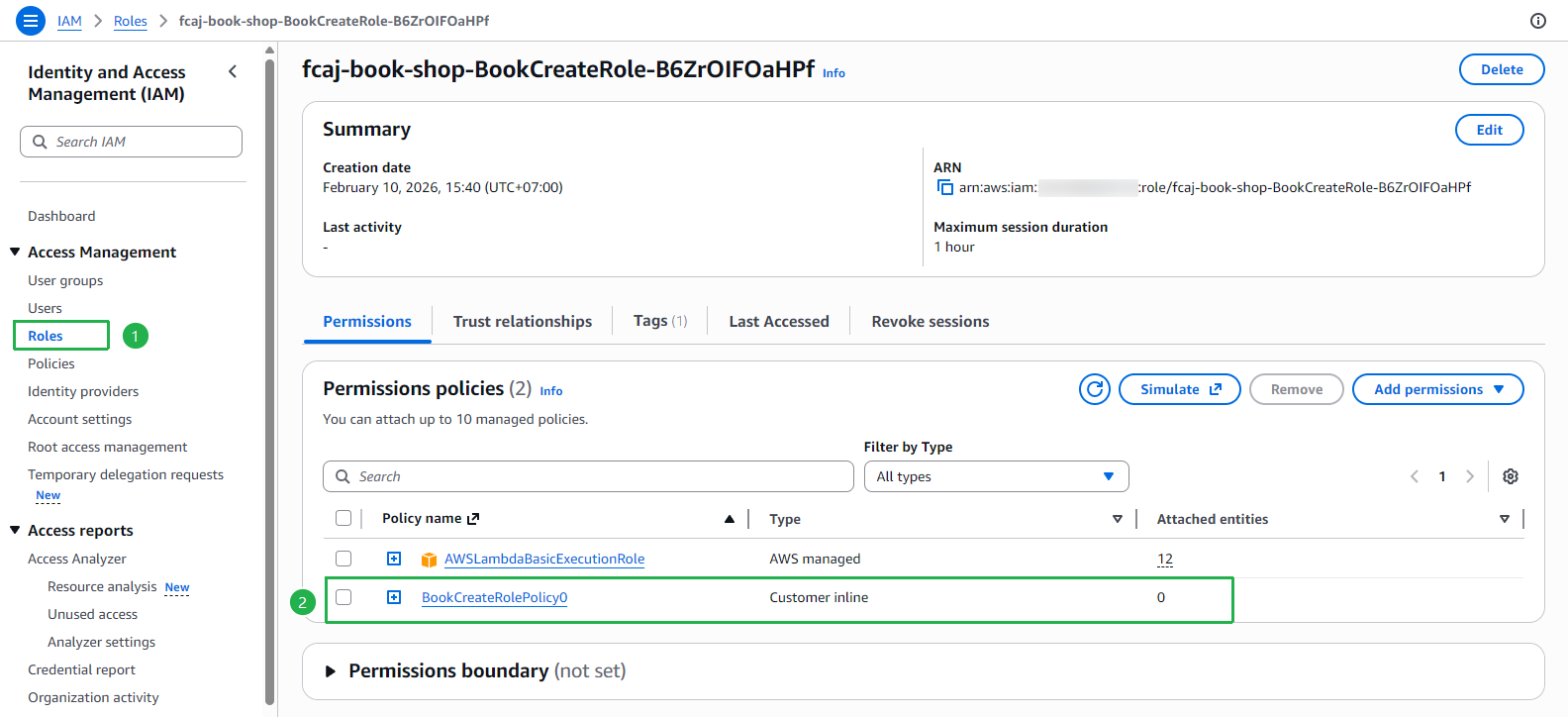
Click on BookCreateRolePolicy0 to expand it. Review the policy JSON that grants
dynamodb:PutItemands3:PutObjectpermissions.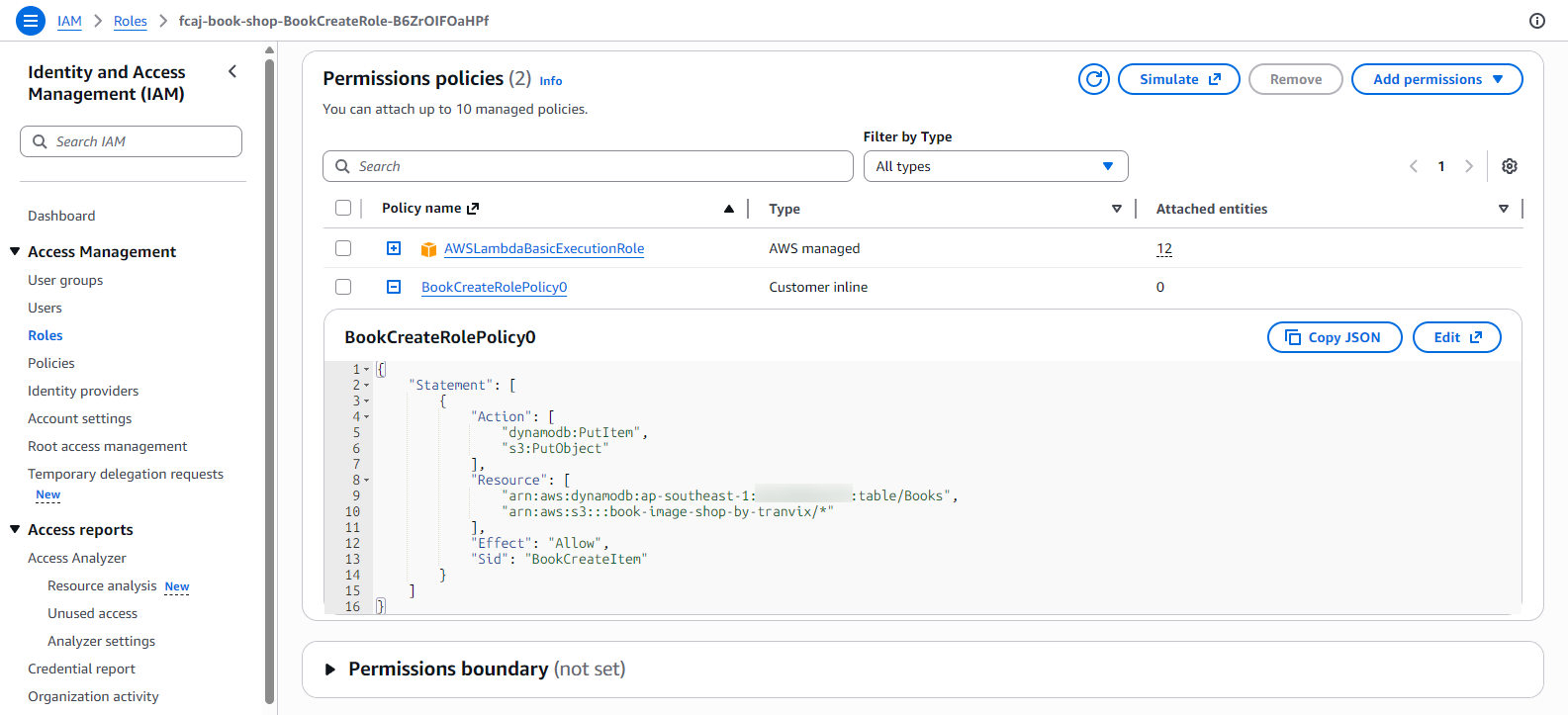
Verify S3 Buckets
Open the S3 console. Search for
book-image. You should see both buckets created:- book-image-resize-shop-by-tranvix
- book-image-shop-by-tranvix
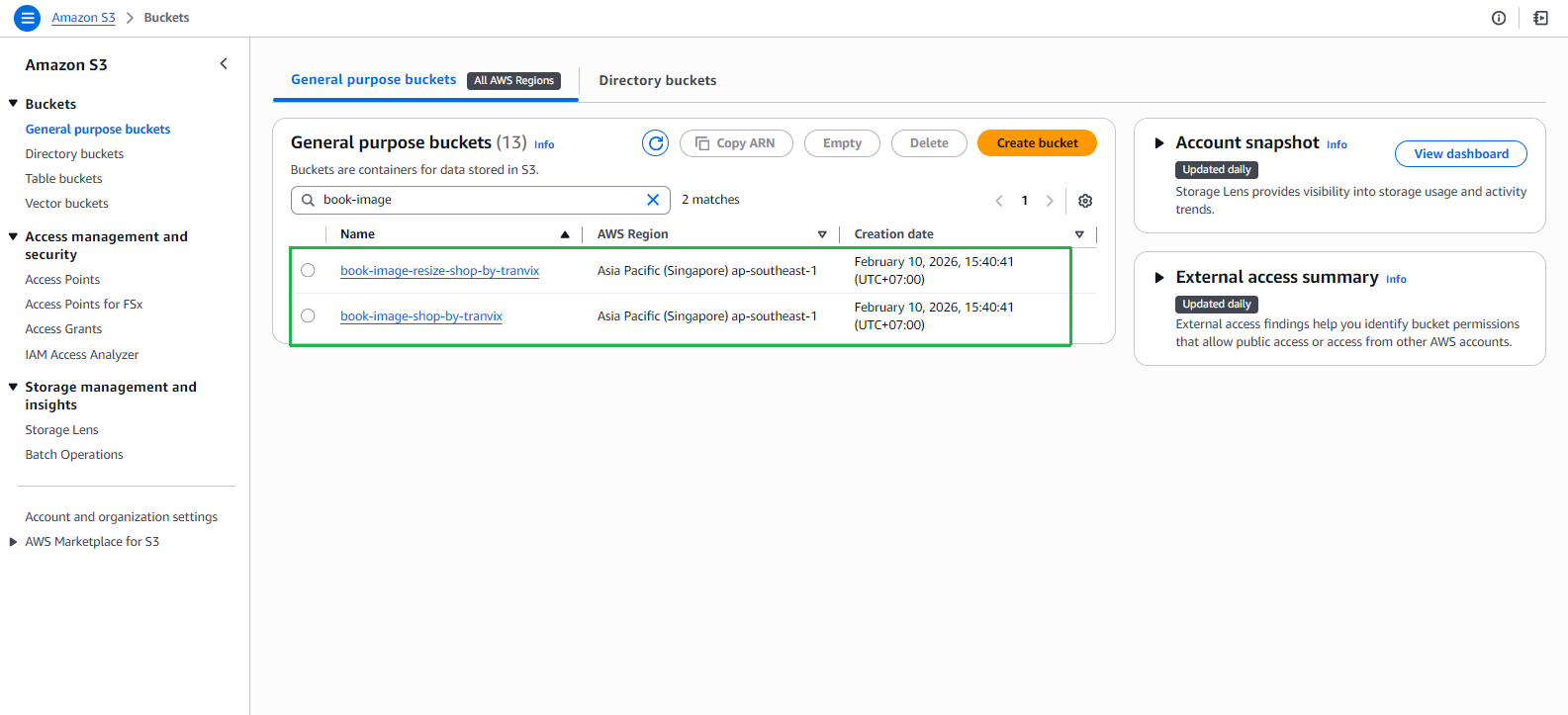
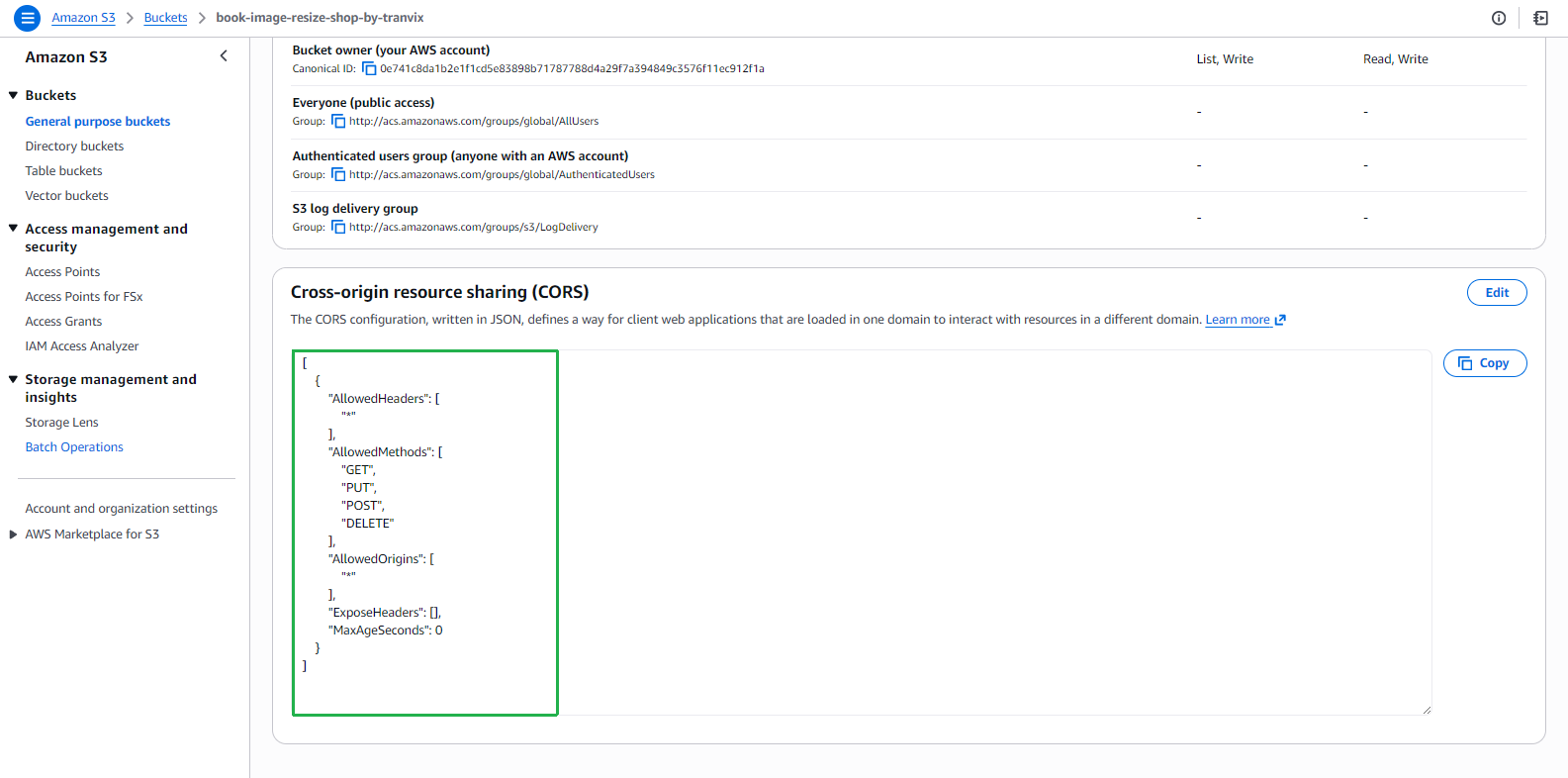
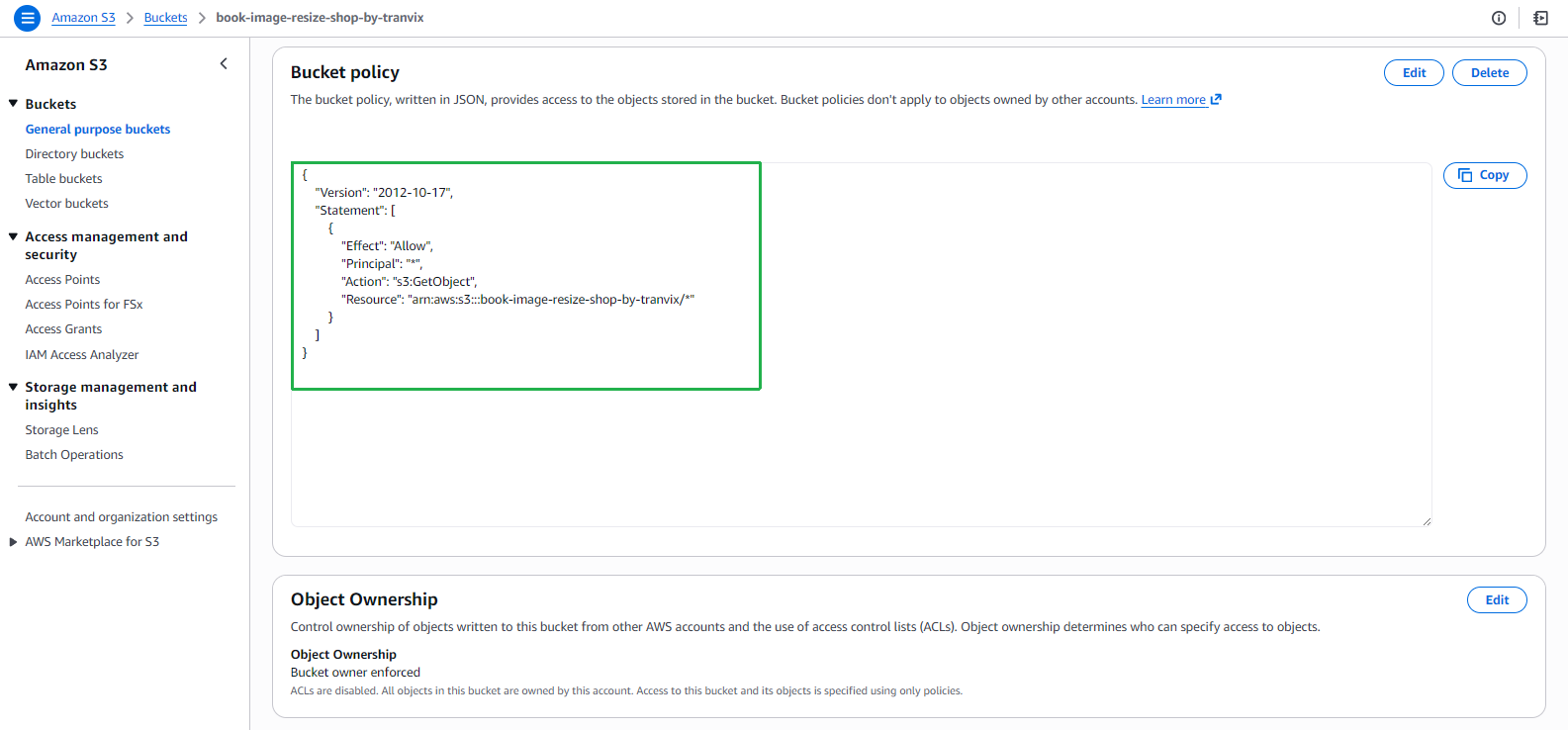
Click on book-image-resize-shop-by-tranvix. Switch to the Permissions tab. Verify the Bucket policy allows public
s3:GetObjectaccess.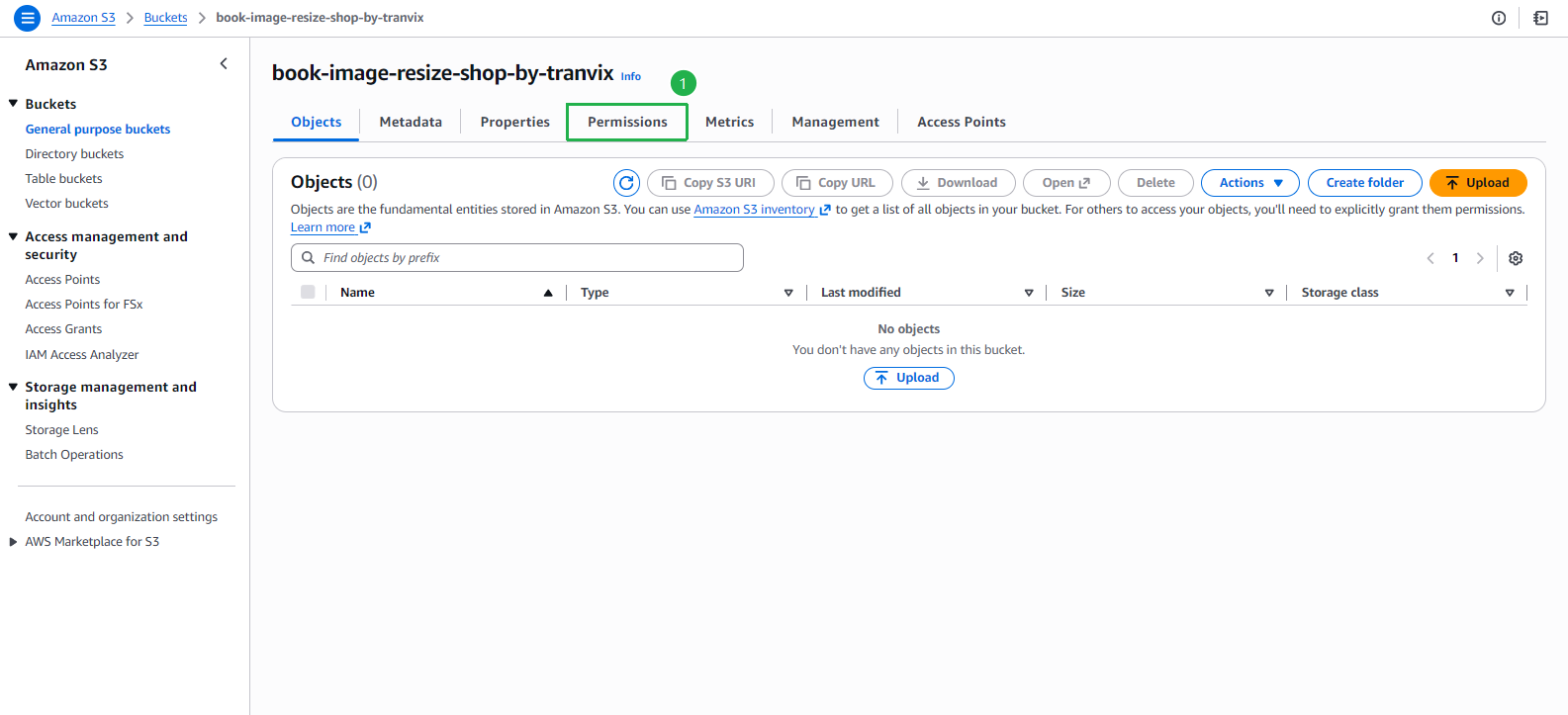
Review the Bucket policy JSON.
Scroll down to the Cross-origin resource sharing (CORS) section. Verify the CORS configuration allows all origins and methods (GET, PUT, POST, DELETE).